


How to Buy Crypto Easily
.jpg)
What Are Cryptocurrencies?
Cryptocurrencies are digital assets that exist entirely online and use advanced technology to record and secure transactions. These digital assets are often referred to as tokens.
So why are they called cryptocurrencies? The name comes from cryptography—the technology used to protect transactions and prevent double-spending, ensuring that the same token cannot be used more than once.
One of the defining characteristics of cryptocurrencies is that they are decentralized. Instead of relying on a central authority, they operate on blockchain technology, a distributed digital ledger shared across a network of participants.
Unlike traditional currencies issued and controlled by banks or governments, cryptocurrencies function independently. No single institution manages the network or has complete control over it.
Transactions take place through a peer-to-peer (P2P) network, allowing users to send and receive assets directly without intermediaries. Before a transaction is added to the blockchain, it must be verified by network participants—miners in Proof-of-Work (PoW) systems or validators in Proof-of-Stake (PoS) systems.
Blockchain networks rely on nodes to remain secure and decentralized. A node is any computer connected to the blockchain, although different nodes perform different roles. Full nodes store the complete blockchain and independently verify transactions, helping enforce network rules. Light nodes store only essential data and depend on full nodes for verification. In PoW networks, mining nodes validate transactions by solving computational problems, while validator nodes perform this role in PoS networks. Bitcoin, for example, is secured by thousands of full nodes and miners working together to maintain the network.
Centralized vs. Decentralized Systems
Although cryptocurrencies exist only in digital form, they have real-world value. They can be stored in digital wallets or on cryptocurrency exchanges and used to pay for goods and services, much like traditional money.
However, cryptocurrencies are not limited to payments. They are also widely used as investment assets, alongside stocks, precious metals, and commodities.
Key Features of Cryptocurrencies
- Decentralized – No single organization controls the network.
- Peer-to-Peer – Users can transfer assets directly without intermediaries.
- Secure – Cryptography protects transactions and network integrity.
- Immutable – Once recorded, blockchain transactions cannot be changed or removed.
- Permissionless – Anyone with internet access can participate in the network and view its public ledger.
- Limited Supply – Many cryptocurrencies have a fixed maximum supply. Bitcoin, for example, is capped at 21 million coins.
- Transparent – Every blockchain transaction is publicly recorded and verifiable.
- Financially Inclusive – Cryptocurrency networks are accessible worldwide, providing financial services to anyone with an internet connection.
Leading Cryptocurrencies
Most people entering the crypto space first hear about Bitcoin and Ethereum, but there are millions of digital assets in existence. Even so, the ten largest cryptocurrencies account for nearly 90% of the total crypto market capitalization.
Bitcoin was the first decentralized cryptocurrency and the earliest successful application of blockchain technology.
Created by the anonymous developer—or group of developers—known as Satoshi Nakamoto, Bitcoin was designed to enable a decentralized digital payment system. As of March 2025, it remains the largest and most valuable cryptocurrency among more than 37 million crypto tokens. If the crypto market were an ocean, Bitcoin would be the dominant shark, representing more than half of the entire ecosystem.
Altcoins are all cryptocurrencies created after Bitcoin. They include thousands of projects with different technologies, goals, and use cases.
In the following lessons, we'll explore Bitcoin in greater detail and examine how altcoins differ from it. With these fundamentals in place, you now have a solid understanding of what cryptocurrencies are and why they have become one of the most significant financial innovations of the digital age.
Step 1: Define Your Investment Goals
Before buying cryptocurrency on YouHodler, take a moment to identify your goals. Are you investing for long-term growth, looking to trade short-term price movements, or planning to use crypto within the digital asset ecosystem? Understanding your objectives will help you choose the right assets and products. As with any investment, cryptocurrency should be part of a diversified financial strategy that balances potential returns with risk.
Step 2: Create Your YouHodler Account
Getting started is simple. Create your YouHodler account, complete the identity verification (KYC) process, and secure your account by enabling two-factor authentication (2FA). This helps protect your funds and ensures compliance with regulatory requirements.
Step 3: Fund Your Account and Buy Crypto
Once your account is verified, you can deposit funds using one of the payment methods supported by YouHodler. Depending on your region, you may be able to use bank transfers, payment cards, or other available options.
After funding your account, you're ready to purchase cryptocurrency. You can choose from a wide range of supported digital assets and buy the amount that best fits your investment strategy.
How to deposit crypto to your YouHodler account
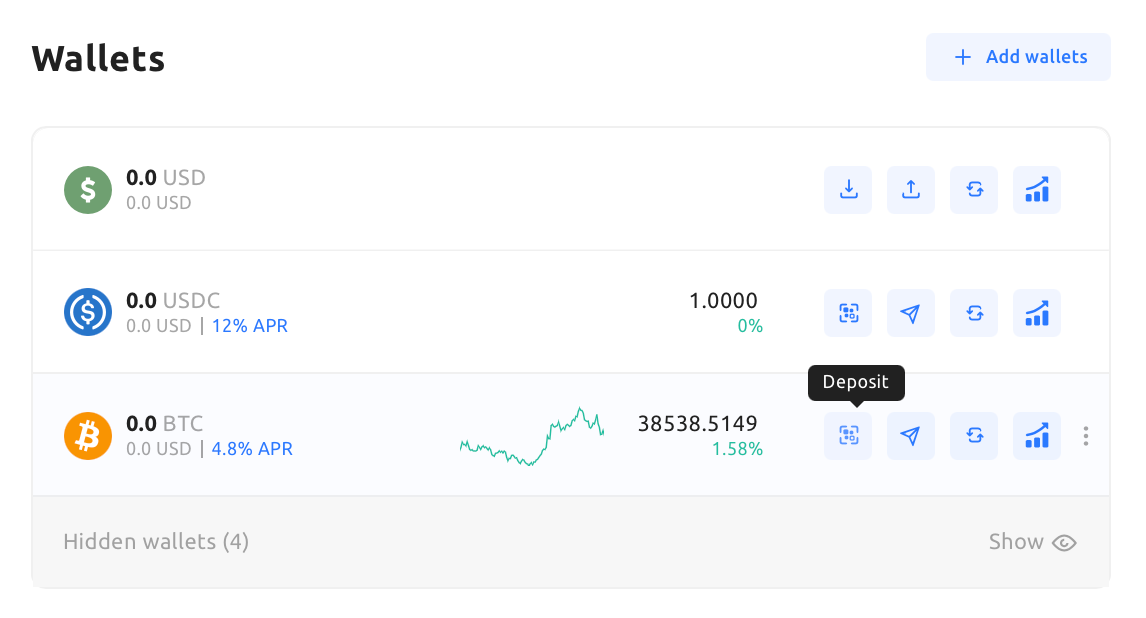
To deposit crypto please go to the Wallets section and click the Deposit button on the crypto wallet of your choice.
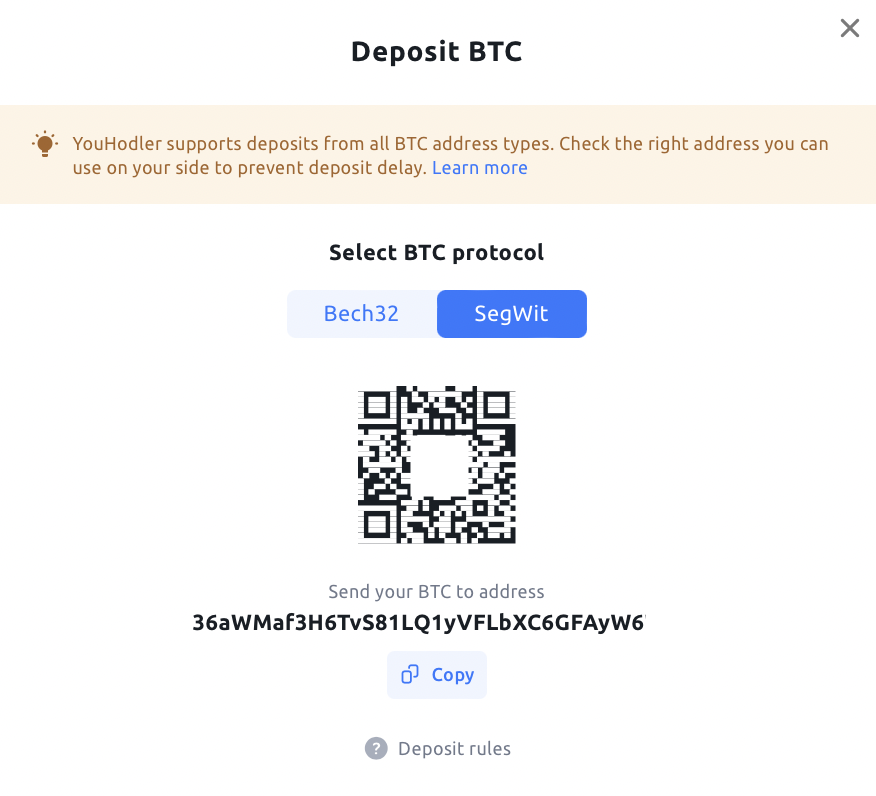
Simply copy your wallet address or scan a QR-code to send your coins to this address.
Once your crypto funds arrive, you will be notified via SMS and email.
Please be advised:
- YouHodler supports two BTC wallet address formats: SegWit and Bech32. Please check networks we support for other coins here;
- By depositing you acknowledge that YouHodler is not responsible for any digital assets sent to the wrong address;
- In the case of sending funds with the wrong transaction Memo ID/Destination tag/Memo, the funds will not be deposited to your YouHodler wallet with no possibility of sending them back to the sender’s wallet.
- Deposits will appear after 2 network confirmations for OMNI network and 10 confirmations for ERC20 network;
- The transaction confirmation time could vary based on the conditions of the corresponding network. For more info please explore this article
Step 4: Secure and Manage Your Assets
After your purchase, your cryptocurrency is securely stored in your YouHodler account, allowing you to manage your portfolio from one place. To further protect your assets, always use a strong password, enable 2FA, and keep your account credentials private.
As your experience grows, you can also explore YouHodler's additional features, including Get Cash, Multi HODL, exchange services, and other tools designed to help you make the most of your digital assets.

Suggested Posts




YouHodler is regulated in Switzerland, the EU and Argentina.

YouHodler SA
Registered financial intermediary

YouHodler Italy S.R.L.
Registered as a VASP with the OAM

YouHodler SA
Registered as VASP with Banco de España

YouHodler SA Branch in Argentina.
Registered as a VASP with the CNV.