


Top 10 Cryptocurrencies to Invest in March 2026
.jpg)
Want to find crypto with a good potential to invest in March? We’ve picked out ten options that might be worth a closer look.
Are you looking to invest in cryptocurrencies for the long term but unsure of where to start? With thousands of crypto assets available, it can be overwhelming to decide which ones to invest in. In this article, we will highlight the best crypto to invest in March 2026, focusing on the top 10 cryptocurrencies that have shown resilience and promise.
What are cryptocurrencies?
Cryptocurrencies are virtual currencies that use cryptography for security. Unlike traditional currencies issued by governments, cryptocurrencies operate on decentralized networks based on blockchain technology. This decentralization means that no single entity, such as a central bank, controls the issuance or value of a cryptocurrency.
How does cryptocurrency work?
Cryptocurrencies operate on decentralized networks using blockchain technology, which serves as a distributed ledger that records all transactions across a network of computers, or nodes. Unlike traditional currencies managed by central banks, cryptocurrencies rely on cryptography to secure transactions and control the creation of new units.
When a transaction is initiated, it is broadcasted to the network, where it is verified by nodes through consensus mechanisms like Proof of Work (PoW) or Proof of Stake (PoS). In PoW, miners compete to solve complex mathematical puzzles to validate transactions and add them to the blockchain, earning cryptocurrency as a reward. In PoS, validators are selected based on the amount of cryptocurrency they hold and are willing to "stake" as collateral, ensuring network security and transaction validation without the need for energy-intensive mining.
Cryptocurrencies are stored in digital wallets, which hold the private keys necessary to sign and authorize transactions. These wallets can be software-based or hardware-based, providing various levels of security and accessibility. Transactions are encrypted and recorded on the blockchain, ensuring their integrity and making it nearly impossible to alter past data, while maintaining a certain degree of anonymity for the participants.
How to choose the best crypto coin to invest in
Choosing the best cryptocurrency to invest in requires careful consideration of several factors, given the volatile and complex nature of the cryptocurrency market. Here are key aspects to evaluate when selecting cryptocurrencies for long-term investment:
- Market capitalization. Market cap is a fundamental metric that provides insight into the relative size and stability of a cryptocurrency. It is calculated by multiplying the current price of the cryptocurrency by its total circulating supply. Cryptocurrencies with higher market cap, like Bitcoin and Ethereum, tend to be more stable, making them more suitable for long-term investment. These assets are often seen as "blue-chip" cryptos, with a proven track record of performance and resilience in the market.
- Technology and use cases. The underlying technology and real-world use cases of a cryptocurrency play a significant role in its long-term viability. A cryptocurrency with innovative technology and practical applications is more likely to gain widespread adoption, leading to sustained growth. When evaluating a cryptocurrency, consider its technical features, scalability, security, and the problems it aims to solve.
- Community support and developer activity. A strong, active community and ongoing developer support are vital indicators of a cryptocurrency's potential for long-term success. A vibrant community ensures that there is interest and engagement around the project, which can lead to increased adoption. Similarly, consistent developer activity indicates that the project is continually improving, addressing security vulnerabilities, and staying competitive.
- Tokenomics. Evaluating token distribution, supply mechanisms, and economic incentives is very important. Projects with well-structured tokenomics that promote long-term value creation are generally more attractive than those with high inflation rates or overly concentrated token ownership.
- Security and audits. Reliable projects prioritize security. Independent code audits, bug bounty programs, and public disclosures about security practices can add credibility and reduce the likelihood of vulnerabilities.
- Regulatory environment. Be aware of the legal status of the cryptocurrency in different regions. Cryptocurrencies facing legal challenges or restrictions in major markets may pose higher risks.
- Historical performance. Analyzing the historical performance of a cryptocurrency can provide valuable insights into its potential future performance. While past performance is not a guarantee of future results, it can help identify trends, such as how a cryptocurrency responds to market cycles or external events.
By carefully analyzing these factors, investors can make more informed decisions and identify cryptocurrencies with strong potential for long-term growth.
Crypto market overview
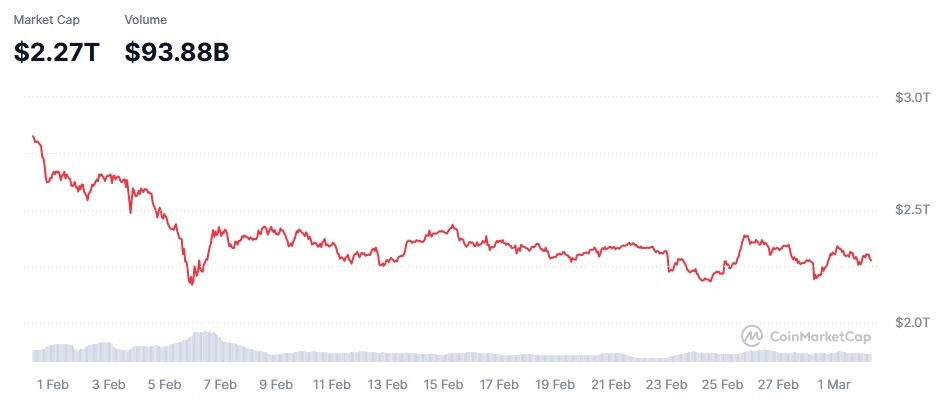
As of early March 2026, the cryptocurrency market is in a consolidation phase following heightened volatility at the start of the year. Total crypto market capitalization stands at approximately $2.2 to $2.4 trillion, according to CoinMarketCap data. Bitcoin has traded in a broad range between $60,000 and $70,000 over recent weeks, while Ethereum has fluctuated around the $1,800 to $2,100 range.
The crypto market in March 2026 presents quite a compelling entry setup. Bitcoin sits roughly 50% below the all-time high it set in late 2025, the Fear and Greed Index has been parked in "Extreme Fear" territory for weeks, and yet the structural foundations of the industry are very strong. Spot ETFs have brought institutional capital onto the table in a way that simply did not exist in previous cycles. Congress passed stablecoin legislation last July. And on March 27, the SEC faces a hard deadline to rule on 91 pending crypto ETF applications covering 24 different tokens.
Top 10 best cryptos to buy now
What is the best cryptocurrency to invest in right now? Although it is impossible to give an exact answer to this question, it's still possible to highlight cryptocurrencies that have a good chance of growth in the long term. Here is our list of the top 10 cryptos to invest in March 2026.
Bitcoin (BTC)
Bitcoin holds a unique position among crypto assets as the structural foundation of the cryptocurrency market. Its security model and decentralization remain unmatched. Spot ETF participation has strengthened Bitcoin’s role as a macro allocation vehicle, broadening access for pension funds, asset managers, and corporate treasuries. Hash rate resilience signals miner confidence, while long-term holder accumulation historically supports price floors during consolidation phases.
On the technical side, the RSI is deeply oversold on weekly timeframes, a condition that has historically preceded sharp recoveries. The $60,000 region has held its position as support through multiple tests, and a reclaim of $100,000 would reopen the path toward new highs.
One of the most significant near-term catalysts is the Federal Reserve chair transition in May 2026, when Powell's term ends. A dovish successor would represent a meaningful liquidity unlock for all risk assets, with Bitcoin historically the one of the first beneficiaries.
Risk tier: Conservative (core holding).
Key statistics (as of March 2, 2026):
- Price: $65,751
- Market cap: $1.31T
- All-time high: $126,198
Ethereum (ETH)
Ethereum remains the dominant smart contract platform entering March 2026, supported by its deep liquidity, broad developer base, and central role in decentralized finance (DeFi) and tokenization. The network benefits from a fee burn mechanism that offsets issuance, especially during periods of elevated on-chain activity. Staking participation remains high, reducing liquid supply and reinforcing long-term holding behavior.
Fundamentally, Ethereum’s position as the primary settlement layer for Layer-2 networks strengthens its value proposition. Rollups such as Arbitrum and Optimism expand transaction capacity while anchoring security to Ethereum mainnet. The growth of real-world asset tokenization and institutional-grade DeFi applications further supports demand for ETH.
Ethereum is trading around $2,000 in early March 2026, a level that represents a drawdown of almost 60% from its all-time high. That magnitude of correction, applied to the asset that hosts approximately 75% of all DeFi total value locked and the vast majority of institutional smart contract activity, creates a gap between price and underlying utility that is difficult to ignore.
The other future catalysts include the upcoming Glamsterdam upgrade in mid-2026, which will potentially increase performance to 10,000 transactions per second.
Risk tier: Moderate to Conservative.
Key statistics (as of March 2, 2026):
- Price: $1,940
- Market cap: $234.22B
- All-time high: $4,953
Solana (SOL)
Solana enters March 2026 as one of the strongest high-performance Layer-1 networks, combining speed, low transaction costs, and a rapidly expanding ecosystem. Its architecture enables high throughput without relying heavily on Layer-2 scaling, which has attracted developers building consumer applications, DeFi protocols, NFTs, and decentralized physical infrastructure networks (DePINs). Stablecoin activity and decentralized exchange (DEX) volumes have shown resilience, reinforcing network utility.
Solana trades around $85 in early March 2026, which puts it approximately 70% below the all-time high of $294 it reached in January 2025. That drawdown appears alarming until you examine what the network has actually been doing during this time. Over the 12 months ended September 2025, the Solana ecosystem generated $2.85 billion in revenue across DeFi, DePINs, and AI applications. That revenue was not speculative. It came from actual on-chain activity.
One of the most significant catalysts for SOL in early 2026 is the Alpenglow upgrade. This replaces Solana's current consensus system with two new components: Votor, which targets block finality in 100 to 150 milliseconds, and Rotor, which improves data propagation efficiency across the validator network. If delivered successfully, Alpenglow would represent a large technical step forward in Solana's history.
Risk tier: Moderate.
Key statistics (as of March 2, 2026):
- Price: $82.86
- Market cap: $47.19B
- All-time high: $294.33
Chainlink (LINK)
Chainlink occupies a position in the crypto infrastructure stack that has no comparable competitors. Its oracle network, which delivers real-world data to smart contracts, is used by the overwhelming majority of DeFi protocols across every major blockchain. That market position was reinforced in August 2025 when Chainlink began a formal collaboration with the U.S. Department of Commerce to bring government economic data on-chain. In January 2026, the SEC approved the first spot Chainlink ETF, opening an institutional purchasing channel that had not previously existed for LINK holders.
The Cross-Chain Interoperability Protocol (CCIP) has become the standard mechanism through which major banks and financial institutions move data between private and public blockchains. This use case has emerged organically as regulated institutions discovered that they needed a trusted, auditable bridge between their internal systems and the public chain infrastructure their clients were demanding. As real-world asset tokenization grows through 2026, every new on-chain asset creates incremental demand for oracle services.
Risk tier: Moderate.
Key statistics (as of March 2, 2026):
- Price: $8.65
- Market cap: $6.11B
- All-time high: $52.88
Tron (TRX)
Tron remains a significant player among Layer-1 networks, driven by its focus on low-cost, high-throughput transactions and massive stablecoin settlement volume. The network hosts the second-largest stablecoin supply of any blockchain after Ethereum. Stablecoin usage has grown rapidly across emerging markets where dollar access through traditional banking is limited, and Tron has become a primary infrastructure layer for that use case in regions including Southeast Asia and Latin America.
The Genius Act, the U.S. stablecoin legislation passed in July 2025, may provide indirect tailwinds for Tron by clarifying the regulatory environment for stablecoin issuers that choose to operate on its network. Greater regulatory clarity tends to encourage institutional participation, and Tron's stablecoin infrastructure position makes it a potential beneficiary of that dynamic.
TRX trades in a range that represents a significant discount to prior highs. The asset is not going to generate the kind of extreme returns that other crypto assets might produce, but it offers a more defensible downside with genuine utility backing the price. The primary risk is continued negative attention from regulators focused on the broader Tron ecosystem and its founder.
Risk tier: Moderate.
Key statistics (as of March 2, 2026):
- Price: $0.28
- Market cap: $26.67B
- All-time high: $0.44
Avalanche (AVAX)
Avalanche occupies a distinct position in the Layer-1 ecosystem. Its subnet architecture allows developers to create custom blockchains with their own validator sets, token economics, and governance rules, all secured by the AVAX staking mechanism. This modularity has proven particularly attractive to enterprise clients and gaming studios that need the security of a major blockchain without the constraints of a shared execution environment. Several large-scale gaming projects launched on Avalanche subnets in 2025, and the real-world asset tokenization narrative continues to point institutions toward Avalanche as a customizable infrastructure layer.
Fundamentally, the subnet model creates recurring demand for AVAX, which is required for staking and network security. As more subnets go live, transaction activity and validator participation can reinforce long-term utility. Gaming projects and asset tokenization platforms expand within the ecosystem, providing diversified use cases beyond pure DeFi exposure.
The most obvious potential near-term catalyst is the SEC's March 27 deadline on pending ETF applications. If the Commission approves Avalanche-based products in the coming weeks, institutional access expands significantly.
Risk tier: Moderate to High.
Key statistics (as of March 2, 2026):
- Price: $8.90
- Market cap: $3.84B
- All-time high: $146
Sui (SUI)
Sui has established itself as a solid Layer-1 of the 2025 to 2026 cycle. Built on the Move programming language originally developed at Meta, the protocol offers a parallel transaction execution model that allows it to process independent transactions simultaneously rather than sequentially. This architectural choice gives Sui a genuine performance advantage over older chains at high throughput levels.
Sui benefits from an active developer community and ongoing ecosystem funding programs aimed at accelerating adoption. The DeFi ecosystem on Sui grew significantly through 2025. The network is also building a meaningful presence in consumer-facing applications, including gaming and AI-integrated dApps, categories that tend to attract retail users who stay on-chain longer than pure yield farmers.
The primary near-term risk for SUI is a token unlock in March 2026 representing approximately 1.13% of total supply.
Risk tier: High.
Key statistics (as of March 2, 2026):
- Price: $0.89
- Market cap: $3.45B
- All-time high: $5.35
Hyperliquid (HYPE)
Hyperliquid stands out as a decentralized perpetual futures exchange built on its own high-performance Layer-1 blockchain offering execution speeds and order book mechanics aimed at rivaling centralized platforms while maintaining non-custodial security. The platform supports leveraged trading across many markets with deep liquidity and minimal slippage, appealing to professional and retail derivatives traders alike. HYPE is the native utility token for the ecosystem, used for governance, staking, gas fees, trading fee discounts, and network security.
Early adoption was fueled by one of the largest community-centric airdrops in DeFi history, with a substantial share of tokens allocated to active users to align incentives and promote engagement. The maximum supply is capped at 1 billion tokens, and ongoing buyback and burn mechanisms funded by protocol revenue aim to reduce circulating supply as usage grows.
From a fundamental viewpoint, Hyperliquid captures a unique intersection of decentralized finance and derivatives markets, an area that has seen explosive growth in recent years. Its transparent on-chain order books and sub-second finality provide a user experience closer to centralized venues while preserving blockchain integrity. Recent metrics show significant trading volume growth and increasing open interest across markets including commodities, indicating traders are using the platform for more than crypto-only exposure.
Risk tier: High.
Key statistics (as of March 2, 2026):
- Price: $30.39
- Market cap: $7.84B
- All-time high: $59.39
Uniswap (UNI)
Uniswap is the largest DEX by volume in the world, a genuinely profitable platform that has historically given very little of that profit back to UNI token holders. That is changing. A major shift in late 2025 was the activation of the “fee switch” via the UNIfication proposal, directing a portion of protocol trading fees to the treasury for token burns and potential revenue distributions.
Moreover, a governance proposal submitted in late February 2026 would expand the protocol's fee switch to eight additional Layer-2 networks and apply a tiered fee model across all v3 liquidity pools. Analysts estimate the change would add approximately $27 million in annual revenue on top of the existing $34 million, with proceeds funding UNI buybacks and burns. The protocol has already burned more than $5.5 million in UNI since activating the initial fee switch.
The token saw a 15% spike on the governance announcement alone in late February. If the governance proposal passes, UNI transitions from a governance token with limited economic rights into a yield-generating, deflationary asset with direct exposure to DEX volume. DEX volume tends to accelerate during bull markets as retail participation increases, creating a compounding effect where higher prices drive more trading, which drives more buybacks, which support higher prices.
Risk tier: High.
Key statistics (as of March 2, 2026):
- Price: $3.74
- Market cap: $2.37B
- All-time high: $44.97
Injective (INJ)
While other smart contract platforms are general-purpose infrastructure that developers adapt for finance, Injective was designed from the ground up to support orderbook trading, derivatives, synthetics, and prediction markets at the protocol level. The result is a platform where financial applications can be built with access to shared liquidity, interoperable assets, and sub-second settlement without requiring developers to build trading infrastructure from scratch. Its architecture, based on the Cosmos SDK with Tendermint Proof-of-Stake consensus, enables smooth interoperability with major networks such as Ethereum, Solana, and Cosmos, helping projects tap into broader liquidity and shared order book depth.
The native INJ token serves multiple roles within the ecosystem. It is used for transaction and trading fees, staking to secure the network, governance participation, and a deflationary mechanism where a portion of fees collected on the protocol is bought back and burned. This supply-reducing mechanism aims to align token scarcity with network activity growth. Recent protocol updates have sought to tighten inflation parameters and enhance deflationary pressure, which could strengthen value capture over time.
The institutional DeFi use case has strengthened considerably since the Genius Act clarified the stablecoin environment and signaled a more constructive regulatory posture in the United States. Injective's compliance-friendly architecture, which includes built-in tools for institutional-grade access control and reporting, positions it well for the on-chain derivatives market that is beginning to attract regulated entities.
Risk tier: High.
Key statistics (as of March 2, 2026):
- Price: $2.98
- Market cap: $298.22M
- All-time high: $52.75
How to find the best new crypto coin to invest in
Researching new crypto coins effectively requires using the right tools and platforms. A wide range of specialized resources can help investors gather information, analyze data, and assess the potential of early-stage projects.
- Coin aggregators. Platforms like CoinGecko and CoinMarketCap offer detailed listings of new cryptocurrencies, including price data, market capitalization, trading volume, and historical charts. These sites also provide access to official project links such as websites, social media accounts, and whitepapers.
- Launchpads and IDO platforms. Platforms like Polkastarter and Binance Launchpad highlight upcoming token launches. These platforms often conduct preliminary screening, giving investors early access to vetted projects.
- Social media and community hubs. Social media platforms such as X, Reddit, and Telegram provide insight into community sentiment and project activity.
- Project review sites. Websites like Messari, TokenInsight, and CryptoRank publish project analyses, ratings, and reports.
- Data platforms. Resources like DefiLlama provide on-chain data visualizations, DeFi protocol metrics, and ecosystem growth statistics. Tracking liquidity, user activity, and transaction volume can reveal how actively a new project is being adopted.
Using a combination of these tools helps build a comprehensive understanding of new crypto coins. A careful research approach, based on objective data rather than hype, remains the most effective way to identify promising opportunities early.

Suggested Posts




YouHodler is regulated in Switzerland, the EU and Argentina.

YouHodler SA
Registered financial intermediary

YouHodler Italy S.R.L.
Registered as a VASP with the OAM

YouHodler SA
Registered as VASP with Banco de España

YouHodler SA Branch in Argentina.
Registered as a VASP with the CNV.