


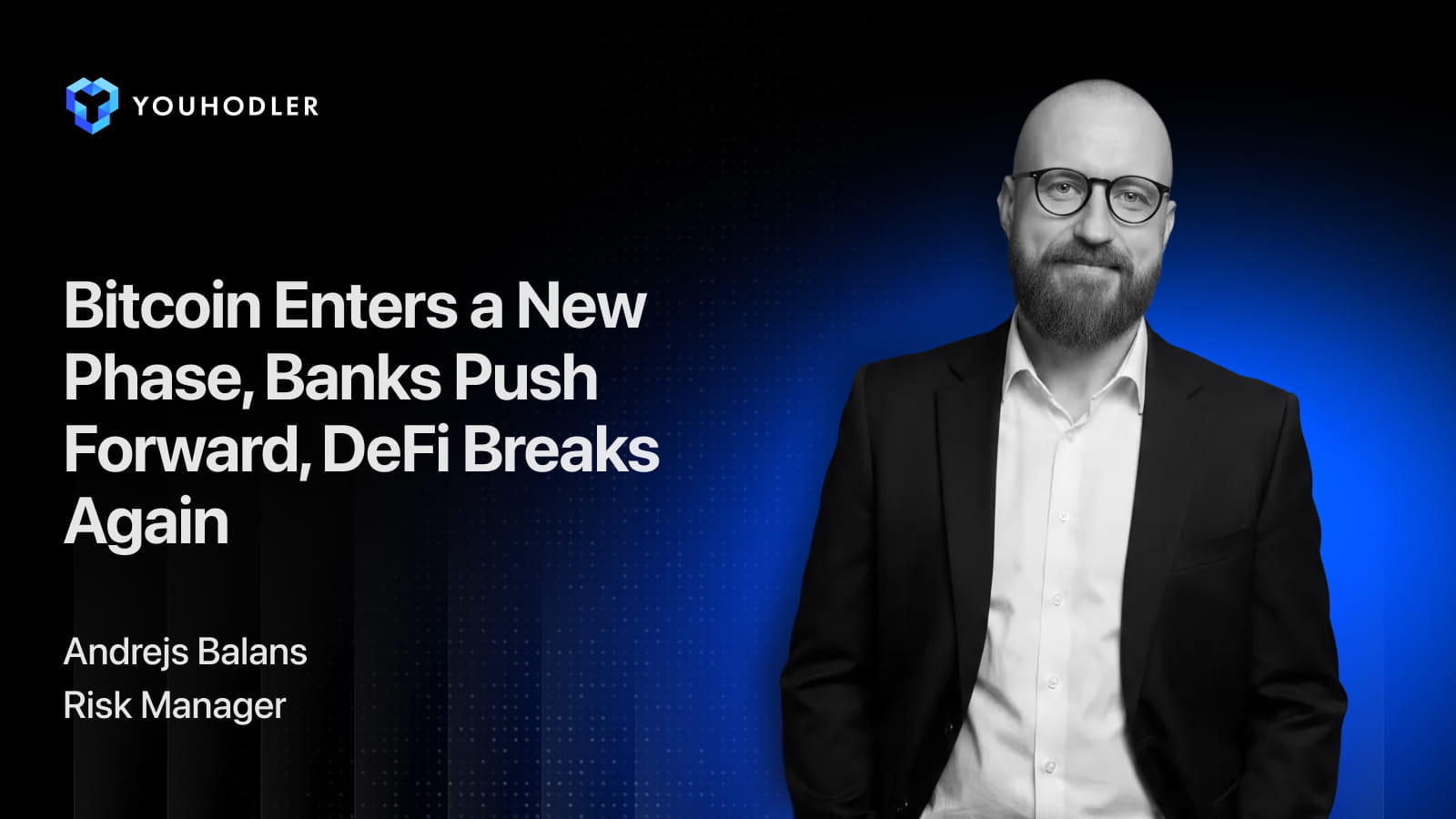
Crypto Market News: Bitcoin Enters a New Phase, Banks Push Forward, DeFi Breaks Again
Highlights
- Bitcoin developers debate freezing quantum-vulnerable coins
- Ethereum posts its busiest quarter with 200 million transactions
- Visa joins Stripe’s Tempo blockchain as a validator
- France pushes banks toward euro-based stablecoins
- Morgan Stanley signals tokenization is entering core operations
- XRP expands into Solana through wrapped assets
- TRON deepens its push into AI infrastructure
- Polkadot bridge exploit losses turn out worse than expected
- Kelp DAO hack spills into Aave liquidity stress
The crypto market is increasingly defined by how systems behave under pressure rather than how they perform during expansion. What stands out is not a single trend, but the way multiple parts of the industry are evolving at different speeds, often exposing weaknesses at the same time as progress.
Infrastructure continues to improve, institutions are moving closer, and networks are scaling in ways that would have been difficult to imagine a few years ago. At the same time, security gaps, interoperability risks, and liquidity fragility remain unresolved, creating a landscape where growth and instability exist side by side.
Bitcoin’s Quantum Debate Turns Practical
The conversation around Bitcoin and quantum computing has moved beyond theory and into design decisions that could affect the network’s long-term structure. Developers are now actively discussing mechanisms that could freeze or phase out coins vulnerable to quantum attacks if such a threat becomes real.
This is not a technical detail buried in developer forums anymore. It is a governance question that touches ownership, fairness, and the balance between security and immutability. Freezing coins, even in extreme scenarios, challenges one of Bitcoin’s core principles, which is that control ultimately sits with the holder of private keys.
At the same time, ignoring the risk is not a viable strategy if the technology ever reaches a critical threshold. The debate shows that Bitcoin is being forced to confront a problem that does not fit neatly into its existing philosophy, which is why it has taken so long to gain traction.
What matters now is not whether quantum computing becomes an immediate threat, but how the network prepares for a scenario where it might. The discussion itself signals a shift from passive acknowledgment to active planning.
Ethereum Shows Demand Is Still There
Ethereum quietly delivered one of the strongest data points in the period by completing around 200 million transactions in a single quarter. That figure does not resolve ongoing debates about scaling or competition, but it does challenge the idea that activity is moving away from the network.
The increase reflects continued usage across DeFi, Layer-2 ecosystems, and broader on-chain activity. While attention often shifts toward newer chains or narratives, Ethereum still appears to be absorbing a large share of real transaction flow.
This matters because network relevance is ultimately measured by usage, not positioning. Even with fragmentation across ecosystems, Ethereum continues to function as a central hub for activity, which reinforces its role despite constant questions about its long-term dominance.
Visa Steps Directly Into Blockchain Infrastructure
Visa joining Stripe’s Tempo blockchain as a validator marks a shift in how traditional payment companies interact with crypto systems. Rather than testing integrations or building external tools, Visa is now participating directly at the infrastructure level.
This is a different kind of involvement. Acting as a validator means taking part in network operations rather than simply connecting to them. It suggests a higher level of commitment and a willingness to engage with blockchain systems as part of core infrastructure rather than experimental technology.
The presence of firms like Visa and Zodia Custody within the same system also signals a convergence between crypto-native and traditional financial players. These are not isolated experiments anymore, but early versions of shared infrastructure where both sides are involved.
At the same time, this raises questions about how decentralized these systems remain as larger players take on more visible roles. The balance between institutional participation and network neutrality is likely to become a recurring theme as adoption grows.
Europe Pushes Stablecoins Into Strategy
France’s push for euro-based stablecoins highlights a growing concern around currency dominance in digital payments. The call for banks to develop tokenized deposits is less about innovation and more about maintaining relevance in a system that is increasingly shaped by dollar-based stablecoins.
This is a strategic move rather than a technical one. If stablecoins become a core part of cross-border finance, the currency they represent will matter just as much as the infrastructure itself.
European banks are now being pushed to engage with this reality, not because they want to experiment, but because they risk being left behind if they do not.
Morgan Stanley Signals Tokenization Moving Inward
Morgan Stanley’s comments on tokenization stand out because they come from within core operations rather than innovation teams. Describing tokenization as the next step for its wealth business suggests a shift from exploration to integration.
This is where tokenization starts to matter. Not as a concept or pilot project, but as part of how large institutions manage assets, liabilities, and client exposure.
The implication is that blockchain is gradually being absorbed into existing financial structures rather than replacing them. That transition tends to happen quietly, but it often has a longer-lasting impact than more visible announcements.
XRP Expands Into Solana
The movement of XRP into the Solana ecosystem through wrapped tokens is a small but meaningful step toward deeper interoperability. While the initial volume remains limited, it shows that assets tied to Ripple are starting to find practical use cases outside their native environment.
This kind of integration matters because it moves beyond announcements and into actual usability. Cross-chain movement has been a long-standing goal, but progress has often been uneven due to technical and security challenges. Even modest adoption suggests that some of these barriers are being addressed.
If this trend continues, it could gradually reshape how liquidity moves across ecosystems. Instead of competing in isolation, networks may become more interconnected, with assets flowing based on opportunity rather than being locked into specific chains.
TRON Pushes Deeper Into AI Infrastructure
TRON is positioning itself more aggressively around AI-related infrastructure, as projects like B.AI launch on the network. This reflects a broader attempt to align with one of the strongest narratives currently shaping the tech sector.
Unlike earlier AI-related announcements in crypto, this move is more focused on infrastructure rather than branding. The goal appears to be building a foundation where AI-driven applications can operate directly on-chain rather than simply attaching AI labels to existing products.
The strategy carries both opportunity and risk. If successful, it could give TRON a clearer role in the next phase of blockchain development. If not, it risks becoming another example of narrative-driven positioning without long-term traction.
Polkadot Exploit Highlights Ongoing Bridge Risks
The Hyperbridge exploit initially appeared unusual but limited, with attackers minting a large amount of tokens but extracting relatively little value. Later updates showed that actual losses were significantly higher than first reported.
This type of incident reinforces a familiar problem. Bridges remain one of the weakest points in the ecosystem, combining complexity with high-value exposure.
The fact that losses were underestimated also raises concerns about transparency and reporting during incidents. Accurate information is critical for maintaining trust, and delays or revisions tend to amplify uncertainty.
Kelp DAO Shock Spreads Into Aave
The Kelp DAO exploit had a wider impact than the initial loss, triggering a liquidity crunch that affected Aave users attempting to withdraw funds. This is a clear example of how interconnected DeFi systems can transmit stress quickly.
What starts as a localized issue can escalate into a broader market problem when liquidity pools, collateral structures, and user behavior are tightly linked. The speed at which this happens remains one of the defining risks of DeFi.
While these systems are designed to be open and efficient, they also create conditions where instability can spread faster than in traditional markets. Managing that balance remains one of the key challenges for the sector.
The Bottom Line
The latest developments show an industry that is progressing, but not evenly. Bitcoin is dealing with long-term structural questions, Ethereum continues to process significant demand, and institutions are moving deeper into blockchain infrastructure.
At the same time, security failures, liquidity stress, and interoperability risks remain persistent. Crypto is not lacking innovation, but it is still working through the complexities that come with operating as a connected financial system rather than a collection of isolated projects.

Suggested Posts




YouHodler is regulated in Switzerland, the EU and Argentina.

YouHodler SA
Registered financial intermediary

YouHodler Italy S.R.L.
Registered as a VASP with the OAM

YouHodler SA
Registered as VASP with Banco de España

YouHodler SA Branch in Argentina.
Registered as a VASP with the CNV.