


XRP Price Prediction 2026-2030
XRP has carved a unique niche in the cryptocurrency landscape by focusing on solving inefficiencies in cross-border payments. This article provides an in-depth look at XRP and explores its future price potential.
As one of the most established cryptocurrencies, XRP has built its reputation as a bridge for cross-border transactions. Unlike many other digital assets, XRP operates with a clear focus on providing fast, cost-effective solutions for global financial institutions. However, since its creation, XRP has sparked debate among financial experts, with some seeing it as a game-changer for international payments and others questioning its long-term viability. This article explores coin and delves into XRP's potential price trajectory from 2026 to 2030.
Nonetheless, one must keep in mind that the cryptocurrencies' prices are influenced by numerous factors and a prediction of these prices will always be unreliable. While our predictions are based on available data and expert opinion, it is crucial for readers to handle these estimates cautiously and conduct their own research before making an investment decision.
What is XRP?
XRP is a digital payment platform designed to facilitate fast, low-cost international money transfers for financial institutions. Unlike many cryptocurrencies, XRP's primary focus is on creating a bridge between traditional banking systems and blockchain technology, using its native cryptocurrency, XRP, to enhance liquidity and reduce transaction costs. Coin operated through RippleNet, a network that allows banks and payment providers to process cross-border transactions seamlessly and efficiently.
XRP’s founders and history
The predecessor of the XRP payment protocol was developed in 2004 by Ryan Fugger. He launched the first incarnation of his system, RipplePay.com, in 2005, but it did not become widespread.
In 2011, Jed McCaleb, Arthur Britto and David Schwartz joined forces to rework Fugger's original concept. In 2012, Chris Larsen joined the team, while Fugger, in turn, left the project. In September 2012, the team founded OpenCoin, with Chris Larsen as CEO. He was later replaced by Brad Garlinghouse.
In September 2013, OpenCoin was rebranded to Ripple Labs.
In 2014, McCaleb left Ripple Labs and founded his own project, Stellar.
In September 2020, the XRPL Foundation, a non-profit organization whose mission is to develop the XRP Ledger, was founded.
In December 2020, the U.S. Securities and Exchange Commission (SEC) filed a lawsuit against Ripple Labs, alleging that XRP was sold as an unregistered security.
In October 2022, the XLS-20 amendment went live on the XRP Ledger, enabling native minting and trading of NFTs.
In July 2023, a U.S. federal court ruled that programmatic sales of XRP on exchanges did not constitute securities transactions, while certain institutional sales did.
In March 2024, the XLS-30 amendment introducing an automated market maker (AMM) feature was activated on the XRP Ledger.
In December 2024, Ripple USD (RLUSD), a U.S. dollar-backed stablecoin issued by Ripple, was officially launched on the XRP Ledger and Ethereum.
In June 2025, Circle launched USDC natively on the XRP Ledger.
In 2025, the XRPL EVM Sidechain was officially launched, bringing Ethereum Virtual Machine compatibility to the XRP Ledger ecosystem and enabling developers to deploy Ethereum-based smart contracts within the XRPL network.
XRP overview
The ecosystem is powered by the XRP Ledger (XRPL) network. The XRPL is Ripple's decentralized public blockchain, which records and stores all transactions that occur on the network.
XRPL relies on a decentralized network of validator nodes that participate in the consensus process. These validators verify transactions and agree on the current state of the XRPL. Unlike Bitcoin and Ethereum, XRPL does not rely on mining or staking rewards. Validators are not incentivized with newly issued tokens or transaction fees, which significantly reduces energy consumption and eliminates competition-based validation. As a result, XRPL is considerably more energy-efficient than proof-of-work blockchains. Anyone can run a validator node and select a Unique Node List (UNL), which is a list of trusted validators chosen by each server operator.
XRPL's consensus mechanism is exceptionally fast, with transactions typically settling in under five seconds. This protocol is also cost-effective, with minimal fees, making it an attractive option for high-volume financial transactions.
Beyond payments, XRPL includes a built-in decentralized exchange (DEX) that allows users to trade issued assets directly on-chain. The DEX supports order books and advanced pathfinding capabilities, enabling automatic currency conversions during transactions. This functionality enhances liquidity efficiency and allows seamless cross-currency payments without relying on external decentralized finance platforms.
XRPL also supports the issuance of custom tokens, including stablecoins, central bank digital currencies (CBDCs), and tokenized real-world assets. Issuers can define specific compliance and authorization rules, making the network attractive for regulated financial institutions and enterprises exploring tokenization strategies.
To further expand programmability, the XRPL ecosystem has introduced smart contract capabilities through innovations such as Hooks and sidechains, including an EVM-compatible sidechain. These developments aim to enhance flexibility and interoperability while preserving the network’s speed and low-cost structure.
RippleNet is a global network for cross-border financial transactions built on the XRPL. Unlike the open source XRPL, RippleNet is a product of Ripple Labs. RippleNet's key components are:
- xCurrent. xCurrent is RippleNet's cross-border payment processing solution. It allows banks to communicate and settle transactions in real-time, with transparency and compliance features. xCurrent is built on the Interledger Protocol (ILP), which enables interoperability between different payment networks, including fiat and cryptocurrencies, and is not bound to use the default XRP cryptocurrency.
- On-Demand Liquidity (ODL). ODL (formerly xRapid) is a service for providing liquidity for fiat currency transactions. Designed to facilitate instantaneous cross-border payments, ODL leverages XRP as a bridge currency between two fiat currencies. When a financial institution or payment provider initiates a cross-border payment, ODL enables it to convert the originating currency into XRP, transfer the XRP across borders, and then convert it into the destination currency on the receiving end. This process is completed in seconds, bypassing the need for pre-funded accounts in destination currencies. ODL is designed to handle large transaction volumes, making it suitable for institutions that require high liquidity.
- xVia. xVia is a user interface for payment initiation on RippleNet. It allows businesses to connect to RippleNet and initiate payments without integrating the underlying infrastructure directly.
XRP coin
XRP is the native cryptocurrency of the XRPL network. The XRP token plays an important role in Ripple's ecosystem, primarily as a bridge currency that facilitates quick and cost-effective cross-border transactions on RippleNet. XRP is designed to provide liquidity for financial institutions and payment providers, enabling them to convert one currency into another through XRP as an intermediary.
XRP has a very low transaction fee (typically a fraction of a cent) as well as high transaction speed, both make it an attractive option for micro-transactions and high-frequency transfers.
XRP statistics (as of 13/02/26)
Advantages and disadvantages of XRP
The price of XRP (XRP) today, March 31, 2026, is $1.32 USD according to real-time market data. XRP is experiencing a pullback, declining -2.25% in the last 24 hours and -2.25% over the past week. Such corrections are common in volatile crypto markets.
Like any other asset, XRP has a number of both advantages and disadvantages to consider when making investment decisions.
Key advantages of XRP
- High transaction speed. XRP transactions are confirmed in just 3-5 seconds, which is much faster than many other cryptocurrencies, let alone traditional banking systems.
- Low transaction fees. The transaction fees for XRP are minimal, usually a fraction of a cent. This makes XRP an attractive option for both small and large transactions, especially for cross-border payments.
- Scalability. The XRP Ledger can process up to approximately 1,500 transactions per second on the base layer. While not the highest throughput among modern blockchains, this capacity is sufficient for institutional payment flows and significantly exceeds the needs of most traditional banking corridors.
- On-Demand Liquidity (ODL). XRP’s ODL service allows financial institutions to use XRP as a bridge currency for liquidity in cross-border transactions. This eliminates the need for pre-funding accounts in various currencies, providing cost savings and enhancing the efficiency of international payments.
- Built-in DEX and tokenization capabilities. The XRP Ledger includes an integrated DEX and supports the issuance of custom tokens, including stablecoins and tokenized real-world assets. These features expand XRP’s ecosystem beyond payments and position XRPL as infrastructure for liquidity provisioning and asset tokenization.
- Established enterprise relationships. Ripple has built long-standing relationships within the global payments industry. While not all partners use XRP directly, Ripple’s enterprise presence strengthens the broader ecosystem and supports real-world integration pathways.
Key disadvantages of XRP
- Centralization concerns. While the XRP Ledger is technically decentralized, critics argue that Ripple Labs holds a large portion of XRP tokens and exercises significant influence over the network’s development and governance. This can be a disadvantage for those who prioritize decentralization as a core principle in blockchain technology.
- Historically payment-focused positioning. While XRPL has expanded into tokenization and smart contract functionality via sidechains and ecosystem upgrades, it still lacks the scale of decentralized finance (DeFi) activity and developer ecosystem seen on platforms like Ethereum or Solana.
- Dependence on partnerships. Ripple's business model heavily relies on its partnerships with banks and financial institutions to drive adoption. Any issues or setbacks in these partnerships could negatively impact the adoption and growth of the XRP network.
- Competition from other payment solutions. XRP faces intense competition from stablecoins (such as USDT and USDC), blockchain networks targeting payment efficiency (e.g., Stellar, Solana), Ethereum-based Layer-2 solutions, as well as improvements in traditional systems like SWIFT gpi.
- Supply concentration. A significant portion of XRP's supply is controlled by Ripple Labs, raising concerns about the potential for market manipulation. Although Ripple has committed to releasing its holdings gradually, the concentration of XRP tokens remains a point of concern for many investors.
XRP price history
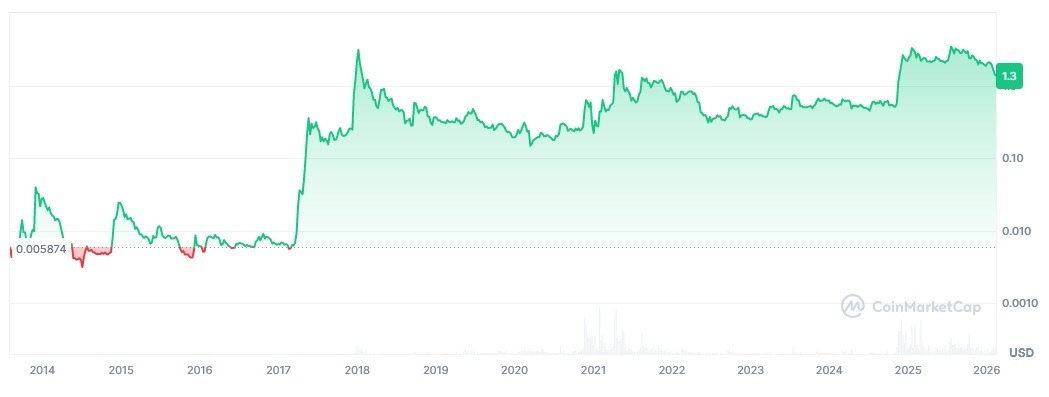
Initially, XRP traded at very low prices, less than a cent. However, in late 2013, its price began to rise and reached a local high of $0.042 in early December 2013. This was followed by a decline and the price reached its all-time low on July 7, 2014. The price then recovered somewhat, but for an extended period the token traded most of the time below $0.01.
In 2017, XRP experienced its first significant price surge, driven by the broader cryptocurrency boom that saw Bitcoin and Ethereum reaching unprecedented highs. As public interest in cryptocurrencies grew, XRP quickly gained attention as one of the top digital assets, particularly due to its focus on the banking and payments sector. In January 2018, XRP reached its all-time high.
Following the explosive growth of 2017, the cryptocurrency market experienced a significant correction in 2018, with XRP's price falling back to around $0.30 by the end of the year. This downward trend continued into 2019, with XRP trading in a relatively narrow range between $0.20 and $0.40.
In 2020, the price began to recover and despite a significant setback in December 2020, reached a local high of $1.96 in April 2021. However, the bearish trend that followed pushed the price back below $0.40 by early summer 2022. After that, the price showed a gradual growth, and starting from the fall of 2023 it consolidated in the range of $0.47-$0.70.
In November 2024, XRP saw further growth as the price went over $1.00 and peaked at around $2.87 in early December. By the end of 2024, XRP was firmly trading above $2.00.
In January 2025, growth continued, and in mid-January, the price reached a local maximum of around $3.40, followed by a slow decline. In July 2025, sharp growth began again, causing the price to surge to $3.66, just shy of its all-time high.
After that, the price started to decline gradually, which is still going on and, after a short recovery period in January 2026, the decline has only accelerated.
XRP price forecasts
XRP technical analysis
Technical analysis for XRP (XRP) as of March 31, 2026 reveals bearish signals. XRP has changed -29.6% since the year opened at $1.88. Currently, 75.0% of indicators signal selling pressure against 0.0% buy signals. The RSI is at 38.73, indicating neutral territory. The 50-day SMA ($1.40) and 200-day SMA ($2.04) confirm the downward pressure. 30-day annualised volatility is 46.87%, with only 12 positive days out of the last 30. The Fear & Greed Index shows 11 (Extreme Fear).
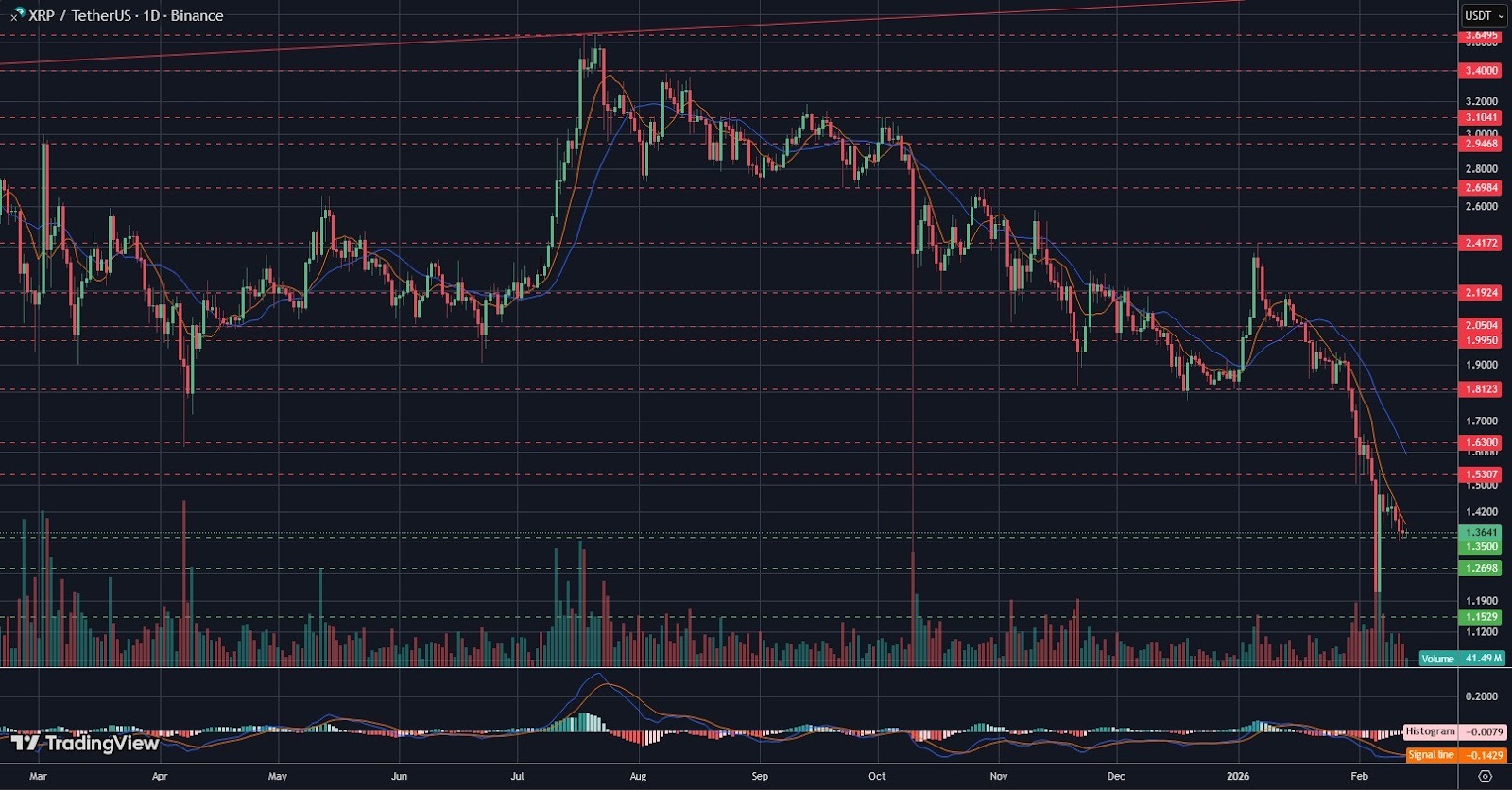
After a sharp drop on February 5 and an equally sharp recovery on February 6, the price declined to the support level of $1.35 but has not yet been able to break it despite several attempts. Moving Averages and MACD are bearish. Parabolic SAR, however, is bullish. The RSI is now slightly above the oversold zone (32.82) and above its Moving Average. The daily trading volume is $2.59B which is -18.51% less than the previous day.
The nearest support levels are $1.15, $1.27 and $1.35. The nearest resistance levels are $1.53, $1.63 and $1.81.
Short-term XRP price prediction
Despite the slowdown in the decline, there are still no clear signs of an imminent market reversal. The most likely scenario for XRP is a break below the $1.35 support level followed by further downside, possibly after a short recovery.
Medium-term XRP price prediction (early 2026)
Early 2026 presents a complex picture for XRP as institutional adoption momentum collides with broader crypto market weakness. Following the decline from July 2025 highs near $3.65 to current levels around $1.35-$1.50, XRP may enter consolidation where ETF demand must offset macroeconomic headwinds. Key drivers include unprecedented institutional flows through XRP ETFs and legal clarity in major jurisdictions.
Significant challenges remain: broader crypto market correction,interest rates reducing risk appetite, and uncertainty around Federal Reserve policy with leadership transition expected mid-2026.
In a base case scenario, XRP consolidates within a $1.00 to $1.60 range through early-to-mid 2026, assuming steady ETF inflows, stable market conditions, gradual adoption in payment corridors, and no major regulatory disruptions.
In an optimistic scenario, strong institutional participation, improving macro conditions, and a broader crypto market uptrend could push XRP into the $1.80 to $2.70 range.
A bearish scenario could see XRP trade within a range of $0.40 to $0.80 if crypto winter conditions emerge, the Fed maintains a hawkish stance, or adoption by financial institutions stalls.
Long-term XRP price forecast 2026-2030
XRP’s long-term outlook mostly depends on adoption by financial institutions, competition from other payment solutions, and overall crypto market cycles. The asset is designed for cross-border settlements, so its future price is closely tied to real-world usage rather than purely speculative demand.
High price scenario
In a high price scenario, XRP achieves broad adoption among banks, payment providers, and remittance services. Regulatory clarity in major markets supports institutional participation, reducing legal uncertainty that has affected XRP in previous years. Partnerships with financial infrastructure providers expand the use of XRP as a bridge asset in international transfers.
At the same time, improvements in the XRP Ledger, including new features such as tokenization support, attract additional use cases beyond payments. Strong growth in the overall crypto market and rising institutional interest also support demand.
Under these conditions, XRP could reach a price range of about $5.00 to $8.50 by the end of 2030.
Moderate price scenario
In a moderate scenario, XRP maintains a stable role in cross-border payments but does not achieve dominant global adoption. Some financial institutions continue using traditional systems or alternative blockchain solutions. Regulatory conditions remain mixed across regions, allowing growth but limiting full institutional integration.
The XRP Ledger continues to function reliably, and periodic upgrades support steady activity, though competition from other payment-focused networks and stablecoin systems slows expansion.
In this case, XRP may trade within a range of roughly $2.00 to $5.00 by 2030.
Low price scenario
In a bearish scenario, XRP faces major setbacks, limiting its use and adoption in key markets. Adoption by banks remains limited, and alternative technologies, including CBDCs and competing blockchain networks, capture most of the cross-border payment market. Reduced demand, declining network activity, or broader market downturns could further pressure the asset. Under these conditions, XRP could trade below $1.00 by 2030, with potential for extended stagnation.
FAQ
Does XRP still have a future?
XRP’s future depends mainly on regulatory clarity, institutional adoption, and competition in cross-border payments. Its prospects are linked to whether banks and payment providers use blockchain-based settlement solutions and whether the XRP Ledger expands its use cases into new areas such as tokenization. Clear legal status and growing partnerships could support its long-term relevance, while strong competition from stablecoins, alternative networks, and CBDCs may limit demand and slow its growth.
How high can XRP rise?
If Ripple’s payment network, RippleNet, sees widespread use among financial institutions and increases demand for XRP as a bridge currency, this could drive significant price growth. Optimistic projections suggest that XRP could reach $10 per token if it becomes integral to large-scale cross-border payments.
Where will XRP be in 2026?
In the most likely scenario, the price of XRP in 2026 will be in the range of $1.00 to $2.00.
Will XRP reach $5?
Reaching $5 is possible but would require several favorable conditions, including clear and supportive regulation in major markets, strong adoption by financial institutions for cross-border payments, and sustained growth in the broader crypto market.
Will XRP reach $20?
This is unlikely, but in the long term, under very favorable developments (or in case of a significant devaluation of the dollar), this cannot be ruled out.
Can XRP reach $100?
Given that XRP's fully diluted market value (price multiplied by maximum supply) would then be $10 trillion, this is only possible in the event of a severe devaluation of the dollar.
LabelValueMarket Cap$81.18BFully Diluted Market Cap$132.31BTrading Volume (24h)$1.94BVolume/Market Cap (24h)0.0239All-time High$3.6500 (2025-07-18)Circulating Supply61,344,583,754 XRP (61.3%)Max Supply100,000,000,000 XRPTotal Supply99,985,695,443 XRP

Suggested Posts





YouHodler is regulated in Switzerland, the EU and Argentina.

YouHodler SA
Registered financial intermediary

YouHodler Italy S.R.L.
Registered as a VASP with the OAM

YouHodler SA
Registered as VASP with Banco de España

YouHodler SA Branch in Argentina.
Registered as a VASP with the CNV.