


DOT Price Prediction 2025-2030

As a platform focused on connecting blockchains, Polkadot plays a crucial role in the further evolution of the blockchain ecosystem. Learn about its technology, strengths and weaknesses, and projections for its token's price up to 2030.
Polkadot (DOT) has gained attention as a blockchain network that focuses on enabling multiple blockchains to interconnect and operate together seamlessly. This article examines Polkadot's fundamentals, its native cryptocurrency DOT, and provides its future price predictions for the next decade.
Note, however, that cryptocurrency prices are influenced by numerous unpredictable factors, making price predictions inherently uncertain. Therefore, readers are advised to treat such forecasts cautiously and perform their own research before making investment choices.
What is Polkadot (DOT)?
Polkadot is basically a blockchain protocol that connects different blockchains so they can work together and share information. It uses a central relay chain and smaller chains called parachains for specific tasks.
Polkadot's founders and history
Polkadot was founded by Dr. Gavin Wood, Robert Habermeier, and Peter Czaban, with the goal of creating a blockchain platform that facilitates interoperability between multiple networks. Dr. Gavin Wood, a co-founder of Ethereum and the creator of the Solidity programming language, envisioned Polkadot as a solution to address the limitations of existing blockchain ecosystems.
The project started in 2016 with the release of the Polkadot whitepaper authored by Dr. Wood. In 2017, the Web3 Foundation was established to support the development of Polkadot and promote decentralized web technologies. The same year, the project conducted its first Initial Coin Offering (ICO), raising $144.3 million to fund development. However, a significant portion of these funds was frozen due to a vulnerability in the Parity wallet, which delayed the project's development.
In 2019, Polkadot's initial proof-of-concept network went live.
In May 2020, the Polkadot mainnet was officially launched.
In June 2023, a new on-chain governance model known as OpenGov was launched. This model aimed to increase decentralization and efficiency by allowing the community to have greater control over network upgrades and changes.
In July 2023, the completion of Polkadot 1.0 was officially announced, marking the achievement of the original vision of the project.
In September 2023, Circle officially launched the USDC stablecoin on the Polkadot network.
May 2024 saw the launch of Asynchronous Backing, the first component of Polkadot 2.0, which reduced block time from 12 seconds to 6 seconds and improved transaction processing efficiency.
In September 2024, Agile Coretime, the second key component of Polkadot 2.0, was launched, replacing the parachain auction system with a more flexible resource allocation model.
In November 2024, the annual DOT issuance was fixed at approximately 120 million, which made the inflation of the token more predictable.
In late 2024 and throughout early 2025, Polkadot introduced Elastic Scaling, a major upgrade that allows parachains to dynamically “rent” additional network cores when they need more throughput and release them when demand drops. Instead of being limited to a single fixed core, parachains can temporarily scale horizontally across multiple cores, enabling significantly higher performance during peak activity.
In September 2025, Polkadot’s community overwhelmingly approved Referendum 1710 (with ~ 81% support) to impose a hard cap on the total DOT supply at 2.1 billion tokens, replacing the previous unlimited issuance model. The new issuance schedule, which begins on March 2026, will reduce inflation every two years, gradually slowing token supply growth until the cap is reached.
Polkadot overview
Polkadot is a next-generation blockchain platform designed to enable interoperability, scalability, and shared security among different blockchain networks. Its innovative architecture connects multiple blockchains, known as parachains, to a central relay chain. This structure allows data and assets to flow seamlessly between otherwise separate networks, addressing the issue of blockchain silos.
The network is structured around a relay chain, which acts as the central hub, providing security and consensus for connected blockchains, known as parachains. Parachains are customizable and optimized for specific use cases, such as decentralized finance (DeFi), gaming, and supply chain tracking. Developers can build these parachains using Polkadot's Substrate framework, which simplifies the creation of purpose-built blockchains.
Polkadot employs a unique consensus mechanism called Nominated Proof of Stake (NPoS), where validators and nominators work together to secure the network and process transactions. This model enhances security while maintaining energy efficiency compared to traditional proof-of-work systems.
Another important component of the platform is the bridges that connect Polkadot to external blockchains such as Ethereum or Bitcoin, which extends its reach and functionality.
Polkadot operates through a diverse set of participants, each playing a role in maintaining the network's functionality, security, and governance. The primary roles are:
- Validators. Validators are responsible for securing the Relay Chain by validating parachain blocks and participating in the consensus mechanism. They verify the information contained in parachain blocks and ensure that transactions are legitimate.
- Nominators. Nominators support the network by selecting and nominating trustworthy validators to stake their DOTs. They indirectly participate in the staking process without needing to run a validator node themselves.
- Collators. Collators operate at the parachain level, collecting transactions from users and producing state transition proofs for validators. They maintain a full node for their specific parachain and are responsible for aggregating transactions into blocks.
- Fishermen. Fishermen monitor the network to detect malicious activities, such as misbehavior by validators. They act as a decentralized security layer by reporting such activities to the network. Fishermen are typically collators or independent nodes and are rewarded with DOT tokens for successfully identifying and reporting malicious behavior.
Polkadot (DOT) token
The DOT token is the native cryptocurrency of the Polkadot network. The key functions of DOT are:
- Governance. DOT tokens grant holders the right to participate in the governance of the Polkadot network. Token holders can vote on proposals related to network upgrades, changes to the protocol, and other important decisions.
- Staking. DOT tokens are used for staking, which is essential for securing the network. Validators stake DOT to secure the network and validate transactions, while nominators delegate their DOT to trusted validators in exchange for staking rewards.
- Bonding. To add new parachains to the network, DOT is bonded as a form of collateral. Once the parachain is removed, the bonded DOT is returned.
DOT currently follows an inflationary model, with no fixed maximum supply. The current inflation rate is approximately 8%. Previously, it was set at 10% annually but has been changed to a fixed issuance of approximately 120 million tokens per year as part of ongoing governance adjustments. Newly minted tokens are distributed primarily to stakers (85%) and a smaller portion (15%) goes to the treasury for funding projects and initiatives within the Polkadot ecosystem.
Furthermore, starting in March 2026, a hard cap on the total DOT supply at 2.1 billion tokens will be imposed, which will ultimately make DOT a deflationary asset.
DOT statistics (as of 24/11/25)
Advantages and disadvantages of Polkadot
Polkadot offers several significant advantages but also comes with some drawbacks.
Key advantages of Polkadot
- Interoperability. One of Polkadot's primary advantages is its ability to facilitate interoperability between different blockchains. This feature allows for seamless data and asset transfers across various blockchain ecosystems, creating a more connected blockchain ecosystem.
- Scalability. Utilizing a multi-chain architecture, Polkadot allows for parallel processing of transactions across multiple parachains. This significantly enhances scalability compared to traditional blockchains.
- Customizability. Parachains can be customized to meet specific needs, allowing developers to create tailored blockchain solutions. This flexibility makes Polkadot a versatile platform for various applications and use cases.
- Decentralized governance. Polkadot's governance model is decentralized, with DOT token holders participating in decision-making processes. This ensures that decisions reflect the community's interests rather than being controlled by a single entity.
- Upgradability. Polkadot enables network upgrades without requiring hard forks. This capability minimizes disruptions and ensures the network can adapt to new technologies and user demands efficiently.
- Token's utility. DOT plays a central role in Polkadot's ecosystem, used for staking, governance, and bonding.
Key disadvantages of Polkadot
- Complexity. The architecture of Polkadot is complex, which can make it challenging for new users and developers to understand, potentially slowing adoption.
- Competition. Polkadot faces competition from other interoperability-focused blockchain platforms, such as Cosmos. These competitors may offer alternative solutions and attract developers and investors away from Polkadot.
- Centralization concerns. Despite its decentralized governance model, some critics argue that Polkadot may still exhibit centralization tendencies due to its reliance on a relatively small number of validators in the NPoS system.
- Inflationary supply. The inflationary nature of DOT's supply may deter long-term holders, as it could dilute the value of tokens over time if network adoption doesn't grow sufficiently to offset it. However, starting in March 2026, a hard cap on the total DOT supply at 2.1 billion tokens will be imposed, making DOT a deflationary asset and thus eliminating this disadvantage.
Polkadot (DOT) price history
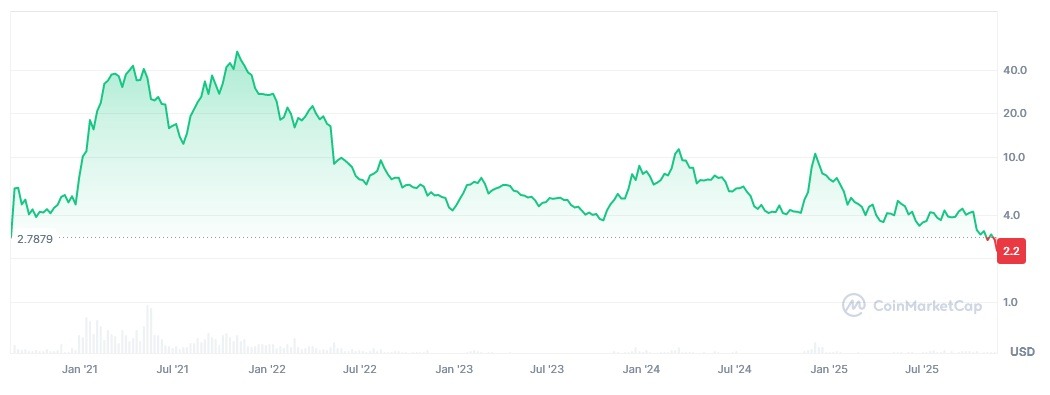
DOT began trading in August 2020, shortly after the network's redenomination that increased the total token supply from 10 million to 1 billion. Initially, the token was traded at a relatively low price, around $2.90. By the end of 2020, DOT had risen to approximately $7.25.
The year 2021 saw a significant bull run in the cryptocurrency market, and Polkadot was no exception. The DOT token experienced a substantial price increase, reaching a high of around $49.70 in May 2021.
Following the peak in May 2021, the DOT token experienced a correction, along with the broader cryptocurrency market. The price declined to around $10.37 in July 2021.
A second rally occurred later in the year as the first parachain auctions launched, bringing DOT to an all-time high of $55 in November 2021.
The year 2022 brought a bear market for the cryptocurrency industry, and the DOT token was not immune to the downturn. DOT began the year trading near $27 but gradually declined, hitting a low of around $4.70 by the end of 2022.
In 2023, DOT saw periods of recovery, but overall the price decline continued until October. At the end of the year, DOT's price started rising, closing the year around $8.20.
In 2024, after reaching a local high of $11.24 in May, the price started to decline again. In November, another price spike occurred, followed by a decline, which is still ongoing.
Polkadot price forecasts
Polkadot (DOT) technical analysis
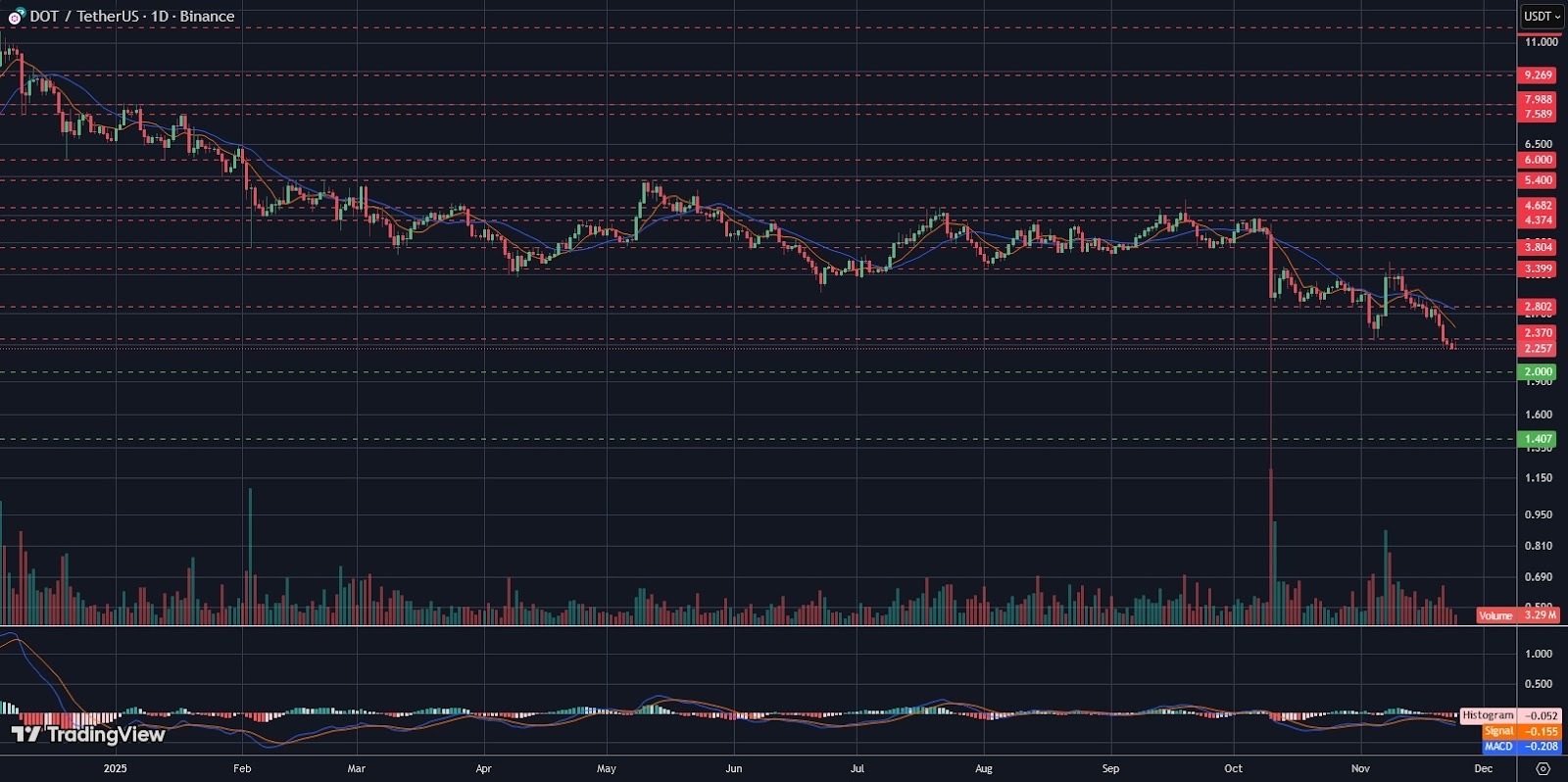
DOT's price is currently falling amid a broader decline in the crypto market. Moving Averages and MACD indicate bearish sentiment. Parabolic SAR, however, is bullish. The RSI is at the borderline of the oversold level, which may indicate a soon rebound but in no way guarantees it. The daily trading volume is $173.77M which is 22.9% more than the previous day.
The nearest support levels are $2.00 and $1.41. The nearest resistance levels are $2.37, $2.80 and $3.40.
Short-term Polkadot coin price prediction
Despite a sharp rebound in early November, DOT soon continued its decline. At the moment, the bearish trend remains intact. The most likely scenario is a further decline to $2.00 and possibly lower. A change in trend will be possible in the event of a clear reversal in the broader cryptocurrency market.
Long-term Polkadot coin price prediction 2026-2030
Polkadot remains one of the most technically ambitious projects in the blockchain space. Its architecture was designed to position Polkadot as the scalable “internet of blockchains.” However, despite strong engineering fundamentals and active developer communities, DOT’s market performance since 2021 has faced persistent challenges. Much of this stems from limited token demand at the base layer, fragmentation of liquidity across parachains, and intense competition from Ethereum L2s, Cosmos, and high-throughput monolithic chains like Solana.
Whether Polkadot can reverse this trend between 2026 and 2030 will depend on its ability to convert technological advantages into visible economic usage: specifically, on-chain liquidity, user activity, and clearer value capture for the DOT token itself. Key catalysts include growth in cross-chain applications, the impact of Agile Coretime replacing auctions, the scarcity effect from the imposition of a hard cap on the total token supply, and the ability of major parachains like Moonbeam, Astar, or Acala to reignite ecosystem-level demand.
High price scenario
In a high price scenario, Polkadot successfully executes its roadmap. Agile Coretime lowers the barrier for launching appchains, stimulating a new wave of specialized chains that use DOT as a settlement and resource asset. Parachains begin to attract materially higher TVL and active users, and Polkadot positions itself as a preferred hub for enterprise-grade and cross-chain applications. If these conditions come together, combined with broader crypto market growth, DOT could regain relevance as a productive ecosystem token with a clear utility.
Under these favorable circumstances, DOT may reach the $18-$30 range by 2030.
Moderate price scenario
A more balanced outlook assumes that Polkadot continues to improve technologically yet struggles to translate its features into visible economic adoption. Parachains maintain steady but modest activity, and cross-chain messaging becomes widely used within the ecosystem but does not attract significant liquidity from external chains. Agile Coretime improves flexibility, but competition from Ethereum L2s, Cosmos chains, and Solana-based apps limits Polkadot’s share of new developer and liquidity inflows. Growth occurs, but incrementally rather than explosively.
In this mid-range scenario, DOT could trade between $7 and $15 by 2030.
Low price scenario
In a pessimistic scenario, Polkadot faces continued challenges in attracting liquidity, developers, and mainstream adoption. Ethereum L2 ecosystems keep consolidating market share, Cosmos expands its consumer-chain model, and Solana’s high-performance monolithic design continues to attract both users and developers, creating strong competition for Polkadot.
In this scenario, DOT could trade between $1.5 and $3 by 2030.
faq-question
.svg)
Does DOT still have a future?
Yes, DOT still has a future. However, as with any cryptocurrency project, Polkadot's future will depend on its ability to adapt to changing market conditions, differentiate itself in a crowded market, maintain robust technological innovation, and foster a thriving ecosystem.
How high can DOT rise?
In an optimistic scenario, DOT could reach $50 or more in the long term.
Will DOT reach $10?
Yes, DOT could reach $10 in the coming years.
Can DOT reach $100?
While $100 is an ambitious target for Polkadot, it doesn't look impossible in the long run. It requires exceptional growth in its ecosystem, sustained demand for its token, lowering token inflation, and a favorable cryptocurrency market.

Suggested Posts
.jpg)



YouHodler is regulated in Switzerland, the EU and Argentina.

YouHodler SA
Registered financial intermediary

YouHodler Italy S.R.L.
Registered as a VASP with the OAM

YouHodler SA
Registered as VASP with Banco de España

YouHodler SA Branch in Argentina.
Registered as a VASP with the CNV.