


Dogecoin Price Prediction 2025-2030
Dogecoin (DOGE) has grown from a meme to a major player in the cryptocurrency market, but what does the future hold? This article explores Dogecoin and its price predictions for the coming years.
Created as a joke, Dogecoin (DOGE) has defied expectations to become one of the most popular and traded cryptocurrencies globally. Despite its lighthearted origins, many now view DOGE as a potential investment. This article will explore Dogecoin and its possible price trajectory from 2025 to 2030.
However, it should be remembered that cryptocurrency prices are shaped by many unpredictable factors and therefore forecasts of these prices are inherently unreliable. Though we base our predictions on available data and expert opinions, it's very important for readers to treat these estimates carefully and do their own research before deciding on any investments.
What is Dogecoin (DOGE)?
Dogecoin (DOGE) is an open-source cryptocurrency created as a fork of Luckycoin, which in turn was a fork of Litecoin. Despite being initially launched as a joke, Dogecoin has gained substantial popularity and market value over the years, thanks to its vibrant community and wide-reaching appeal.
Dogecoin's founders and history
Dogecoin (DOGE), launched in December 2013 by Billy Markus from Portland, USA, and Jackson Palmer from Sydney, Australia, began as a joke cryptocurrency inspired by the popular "Doge" internet meme featuring a Shiba Inu dog. Despite its humorous start, Dogecoin soon garnered attention from the cryptocurrency community and beyond. The coin's mascot, the Shiba Inu dog, quickly became an iconic symbol in the crypto world.
In March 2014, there was a major update to the Dogecoin blockchain, which removed the maximum supply limit and made issuance a fixed value.
In 2014, Marcus and Palmer left the project. They were replaced by a group of developers who began to fulfill the functions of GitHub repository maintainers.
In 2014, members of the Dogecoin team created the Dogecoin Foundation to provide governance and support for the project. However, after a few years, the Foundation's activity declined. In 2021, the Fund was relaunched with new advisors, including Ethereum co-founder Vitalik Buterin, Elon Musk's longtime associate Jared Birchall, Dogecoin co-creator Billy Marcus, and developer Max Keller.
In 2022, the Dogecoin Foundation published a development plan for Dogecoin, including setting up nodes via Starlink satellites, implementing staking mechanisms, and launching Layer-2 apps.
In 2025, the Dogecoin ecosystem saw its most significant technical expansion with the introduction of DogeOS, an independent Layer-2 project designed to bring smart contracts, tokenization, zk-rollups, and broader application support to Dogecoin without altering its PoW-based Layer-1 chain. First publicly presented by the MyDoge team and highlighted through development updates and funding announcements in spring–summer 2025, DogeOS includes an EVM-compatible virtual machine, developer tooling, and a proposal to add native ZK-proof verification (OP_CHECKZKP) to Dogecoin Core to enable secure L2 scaling. As of late 2025, DogeOS is in active development with a working devnet, growing tooling, and secured venture funding, positioning it as the leading effort to extend Dogecoin beyond payments into a full application ecosystem.
Dogecoin overview
Dogecoin operates on a proof-of-work (PoW) consensus mechanism, much like Bitcoin, where miners validate transactions and secure the network by solving complex mathematical puzzles. This is not surprising since Dogecoin is a fork of Luckycoin, which is a fork of Litecoin, which in turn is a fork of Bitcoin.
The important feature of DOGE is the Auxiliary proof-of-work (AuxPoW) mining mechanism. The concept of AuxPoW enables miners to contribute their computational power to multiple blockchains simultaneously, effectively allowing them to mine both Dogecoin and Litecoin without incurring additional costs for energy or hardware. DOGE's transition to AuxPoW was proposed by Litecoin founder Charlie Lee in 2014 as a mechanism to increase resistance to the 51% attack for both networks. This is possible by the fact that both Dogecoin and Litecoin use the Scrypt algorithm for their PoW mechanisms.
One important difference between Dogecoin and both Litecoin and Bitcoin is its supply model. While Bitcoin and Litecoin are deflationary assets whose maximum supply is limited, Dogecoin is an inflationary asset. It doesn't have a halving mechanism, its reward per block doesn't change, so its maximum supply is unlimited. However, since its yearly issuance is fixed at 5,256 billion DOGE, each year the number of new coins issued is a smaller and smaller percentage of the already existing coins. As a result, the Dogecoin inflation rate decreases every year.
Key differences between Dogecoin, Litecoin and Bitcoin
The Dogecoin community played a crucial role in the coin's success, turning it from a joke cryptocurrency into a widely recognized digital asset. Over the years, community members have rallied behind various causes, from sponsoring NASCAR drivers to raising funds for charitable donations like sending the Jamaican bobsled team to the Winter Olympics. This strong grassroots support has helped Dogecoin gain significant visibility, and the viral nature of its social media presence has driven its adoption. In addition, influencers such as Elon Musk have also noticeably boosted Dogecoin's popularity.
Dogecoin (DOGE) coin
The native coin of the Dogecoin blockchain is DOGE. Its main purpose is the same as its predecessors, Bitcoin and Litecoin - to be used as a cryptocurrency. DOGE's low transaction fees and fast processing times make it well-suited for micro-transactions.
DOGE statistics (as of 19/11/25)
Advantages and disadvantages of Dogecoin
Dogecoin (DOGE) is one of the most well-known cryptocurrencies, largely due to its meme origins, strong community, and widespread media attention. However, like all digital assets, it has both strengths and weaknesses that potential investors should consider.
Key advantages of Dogecoin
- Strong and active community. One of Dogecoin's greatest strengths is its large, dedicated community. Unlike many other cryptocurrencies, which often target institutional investors and developers, Dogecoin has built a reputation as “the people's coin.” This communal spirit has contributed to the coin's widespread popularity and visibility, helping it maintain relevance over the years.
- Fast and low-cost transactions. Dogecoin's blockchain processes transactions rather quickly, with an average block time of one minute. This, combined with its low transaction fees, makes Dogecoin an attractive option for smaller, everyday transactions and micro-payments, such as tipping content creators online. Sure, there are now already blockchains with much faster and cheaper transactions, but many of them have their own specific drawbacks.
- Accessibility and ease of use. Dogecoin has a more approachable and less technical image compared to many other cryptocurrencies. This accessibility has drawn in a broad audience, including users who are new to cryptocurrency. It is listed on most major cryptocurrency exchanges and can be relatively easily traded for fiat currencies, making it widely accessible to investors and traders alike.
- Widespread recognition. Despite its origins as a joke, Dogecoin has gained widespread recognition. It has benefited from significant media coverage, celebrity endorsements, and social media hype. High-profile figures such as Elon Musk have brought additional attention to Dogecoin, driving price spikes and increased adoption.
Key disadvantages of Dogecoin
- Limited development and innovation. Dogecoin has seen relatively little active development compared to other major cryptocurrencies. The coin was originally created as a fun experiment, and its code has not been significantly updated to include advanced features. This lack of ongoing innovation limits its potential for use.
- High volatility and speculative nature. Dogecoin's price is highly volatile, largely driven by speculation, social media trends, and short-term trading. While this volatility can lead to rapid price increases, it also means Dogecoin is prone to sharp and sudden corrections. Dogecoin's price movements are often disconnected from technical development or adoption, relying heavily on market sentiment.
- Limited use cases and adoption. Despite its widespread popularity, Dogecoin's real-world use cases remain relatively limited. While it is commonly used for tipping, donations, and small online transactions, Dogecoin has yet to achieve widespread merchant adoption or integration into decentralized finance (DeFi) ecosystems.
- Perception as a “meme coin”. Dogecoin's origins as a meme-based cryptocurrency, while contributing to its popularity, also undermine its credibility in the eyes of more serious investors. Many view Dogecoin as a speculative asset without any intrinsic value, driven primarily by social media hype rather than underlying technology or real-world use cases.
Dogecoin (DOGE) price history
Since its inception in December 2013, Dogecoin has experienced 3 major price surges. After an initial spike in interest in the coin, the price began to fall and reached its all-time low on May 7, 2015. The first significant increase in the DOGE price occurred in the spring of 2017 as part of a broader cryptocurrency market rally. The latter part of 2017 saw an explosive growth in the cryptocurrency market, with Bitcoin reaching unprecedented prices. This boom created a speculative environment that benefited many altcoins, including Dogecoin.
After that, the coin's price remained relatively stable until late 2020 when it began a dramatic ascent, fueled by social media buzz and the support of high-profile figures like Elon Musk. The most notable price rally occurred in January 2021, when Dogecoin's value skyrocketed from around $0.02 to an all-time high of nearly $0.74.
Since then, the price has experienced considerable volatility, with several ups and downs, but is still well above pre-2021 levels.
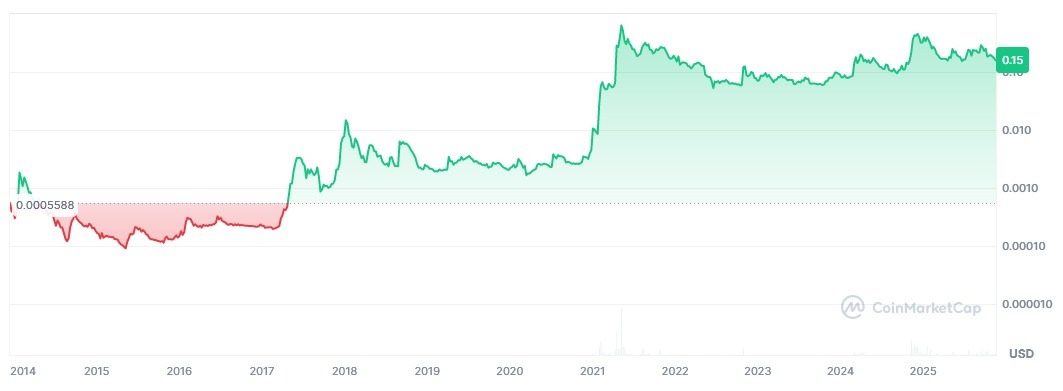
alt: DOGE/USD historical logarithmic price chart
Dogecoin price forecast
Dogecoin (DOGE) technical analysis
Currently, DOGE's price is falling amid a general decline in the crypto market. Moving Averages and Parabolic SAR indicate bearish sentiment. MACD is neutral. The RSI is 39.54 and is slightly above its Moving Average, which is a weak bullish signal. The daily trading volume is $1.91B which is a whopping -42.69% less than the previous day.
The nearest support levels are $0.15, $0.142, and $0.13. The nearest resistance levels are $0.18, $0.19 and $0.205.
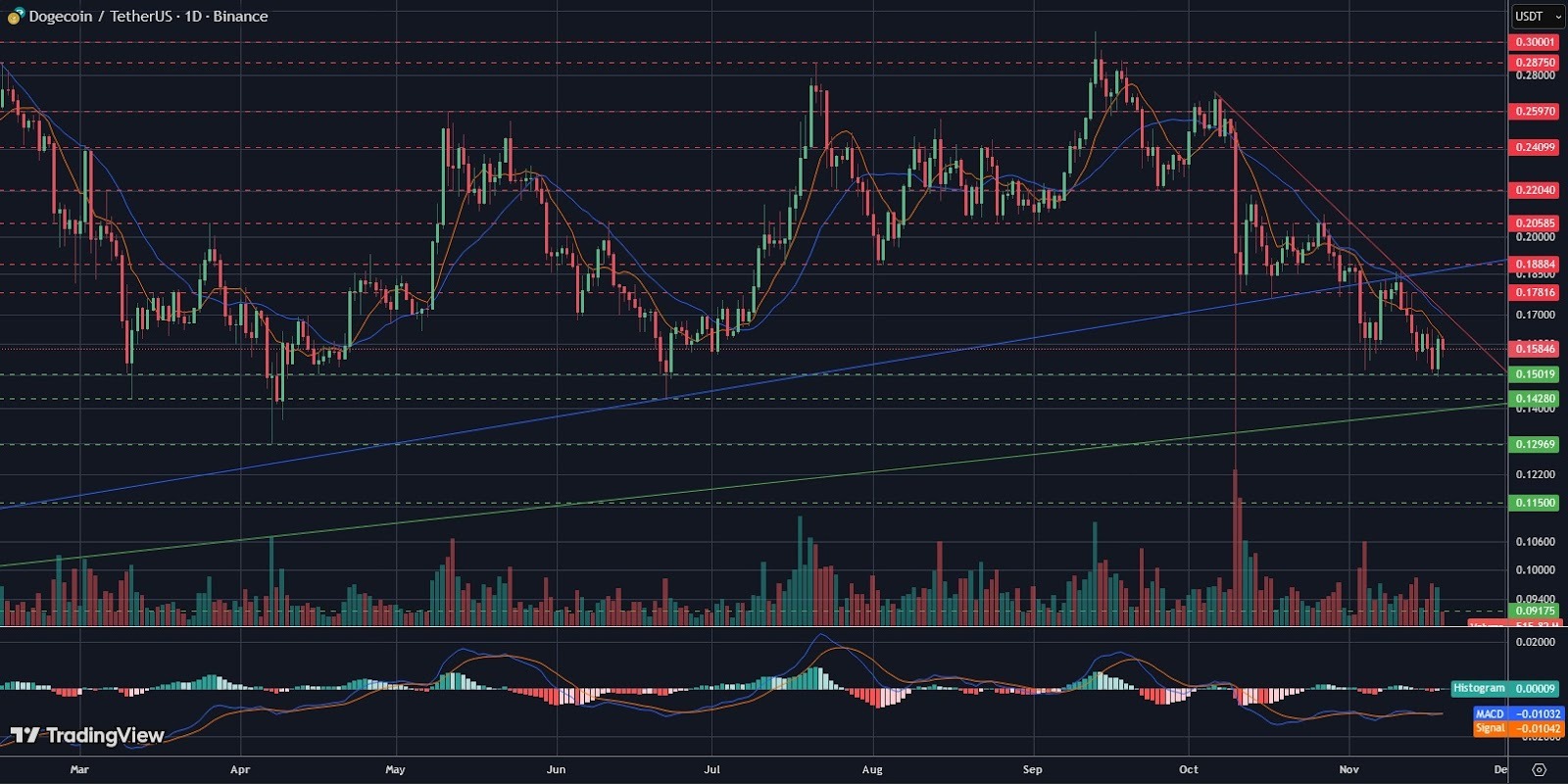
alt: DOGE/USDT daily logarithmic chart
Short-term DOGE price prediction
DOGE price behavior in the near future mainly depends on the state of the cryptocurrency market in general and the memecoin market in particular. Currently, market volatility and trading volumes are relatively low. Further downward movement appears more likely, though the probability of a relief rally or at least short-term rebound is still meaningful.
Long-term DOGE price prediction 2026-2030
Despite Dogecoin's huge success, its long-term future remains uncertain. The project is not innovative in any way, and cannot offer the user something that its competitors do not offer. By and large, the main advantage of DOGE is its community, and the prospects of this cryptocurrency depend entirely on the hype and support of the community and influencers.
That said, initiatives involving L2 and ZK proofs cand significantly increase Dogecoin's utility. If they are implemented, DOGE can cease to be just a “meme coin for payments” and become a full-fledged blockchain for dApps.
However, Dogecoin will have to compete with more mature and functional ecosystems such as Ethereum, Solana, and others. To attract developers, DogeOS and L2 projects will need to offer competitive speeds, costs, and infrastructure.
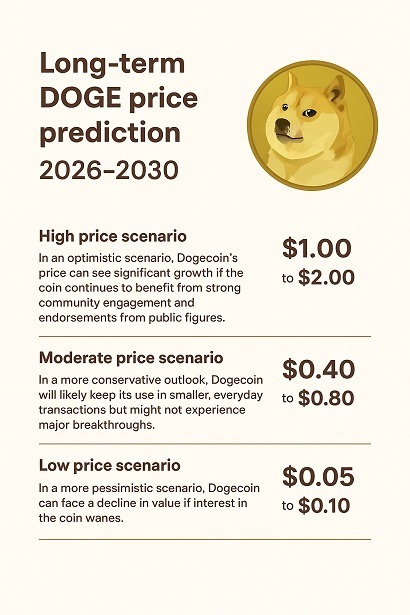
High price scenario
In an optimistic scenario, Dogecoin benefits not only from strong community engagement and high-profile endorsements but also from successful execution of L2 technologies. Functional rollups, growing developer participation, and wider commercial acceptance for payments and microtransactions can all reinforce demand. If Dogecoin becomes meaningfully used both as a payment asset and as the settlement layer for a growing L2 ecosystem, its long-term upside expands considerably. Under these favorable conditions, DOGE can reach $1.00 to $2.00 by 2030.
Moderate price scenario
In a more conservative outlook, Dogecoin’s L2 ambitions progress slowly or remain limited to niche uses, while its primary role stays centered around everyday transactions, tipping, and community-driven activity. Some incremental adoption may come from businesses or lightweight applications, but without decisive breakthroughs in L2 usage or developer traction, growth will be steady rather than explosive. In this scenario, Dogecoin’s price may settle in the $0.40 to $0.80 range by 2030.
Low price scenario
In a pessimistic scenario, developer interest in DogeOS and L2 efforts stalls, technical upgrades fail to gain traction, or competition from more advanced ecosystems overwhelms Dogecoin’s attempts to evolve. A decline in community engagement, lack of real utility, setbacks in L2 security, or adverse regulatory developments can further diminish long-term prospects. In such conditions, DOGE can retreat to the $0.05 to $0.10 range by 2030.
Wallet Investor Dogecoin crypto price prediction for 2025-2030
Wallet Investor expects DOGE's price to rise slowly in the coming years. According to their models the coin's average price will be $0.144 at the end of 2025, $0.197 at the end of 2026, $0.250 at the end of 2027, and $0.409 in 5 years, in November 2030.
DigitalCoinPrice Dogecoin crypto price prediction for 2025-2030
DigitalCoinPrice predicts a more notable price increase. They believe the average price will be $0.21 at the end of 2025, $0.37 at the end of 2026, $0.50 at the end of 2027, and $0.79 at the end of 2030.
Changelly Dogecoin crypto price prediction for 2025-2030
Changelly also predicts DOGE's price growth. According to them, Dogecoin's price will be in the range of $0.165 - $0.181 in 2025, in the range of $0.177 - $0.223 in 2026, in the range of $0.230 - $0.295 in 2027, and in the range of $0.747 - $0.857 in 2030.
faq-question
.svg)
Does DOGE still have a future?
Dogecoin still has a potential, but it remains a highly speculative, volatile memecoin with an uncertain long term outlook. It has certainly demonstrated remarkable staying power for what began as a joke cryptocurrency. But DOGE's inflationary supply and its dependence on hype and social media support can severely limit its growth.
Will Dogecoin reach $1?
While adoption and use cases of Dogecoin have to grow markedly for this to happen, it is still possible.
How high can DOGE rise?
In a very optimistic scenario, DOGE could reach $2 or more in the long term.
Is Dogecoin (DOGE) a good investment?
As a meme coin, Dogecoin is a high risk investment, even when compared to other cryptocurrencies. Investing in it can bring both good profits and severe losses.
How to buy Dogecoin?
Dogecoin is one of the most recognizable cryptocurrencies with a large market cap. You can buy it on most of the major centralized crypto exchanges. On the YouHodler platform, you can exchange other cryptocurrencies for Dogecoin, as well as buy it with a credit card or your SEPA bank account.

Suggested Posts
.jpg)



YouHodler is regulated in Switzerland, the EU and Argentina.

YouHodler SA
Registered financial intermediary

YouHodler Italy S.R.L.
Registered as a VASP with the OAM

YouHodler SA
Registered as VASP with Banco de España

YouHodler SA Branch in Argentina.
Registered as a VASP with the CNV.