


Crypto to Invest in November 2025
Top 10 Cryptocurrencies to Invest in November 2025
Want to find crypto with a good potential to invest in November? We’ve picked out ten options that might be worth a closer look.
Are you looking to invest in cryptocurrencies for the long term but unsure of where to start? With thousands of crypto assets available, it can be overwhelming to decide which ones to invest in. In this article, we will highlight the best crypto to invest in November 2025, focusing on the top 10 cryptocurrencies that have shown resilience and promise.
What are cryptocurrencies?
Cryptocurrencies are virtual currencies that use cryptography for security. Unlike traditional currencies issued by governments, cryptocurrencies operate on decentralized networks based on blockchain technology. This decentralization means that no single entity, such as a central bank, controls the issuance or value of a cryptocurrency.
How does cryptocurrency work?
Cryptocurrencies operate on decentralized networks using blockchain technology, which serves as a distributed ledger that records all transactions across a network of computers, or nodes. Unlike traditional currencies managed by central banks, cryptocurrencies rely on cryptography to secure transactions and control the creation of new units.
When a transaction is initiated, it is broadcasted to the network, where it is verified by nodes through consensus mechanisms like Proof of Work (PoW) or Proof of Stake (PoS). In PoW, miners compete to solve complex mathematical puzzles to validate transactions and add them to the blockchain, earning cryptocurrency as a reward. In PoS, validators are selected based on the amount of cryptocurrency they hold and are willing to "stake" as collateral, ensuring network security and transaction validation without the need for energy-intensive mining.
Cryptocurrencies are stored in digital wallets, which hold the private keys necessary to sign and authorize transactions. These wallets can be software-based or hardware-based, providing various levels of security and accessibility. Transactions are encrypted and recorded on the blockchain, ensuring their integrity and making it nearly impossible to alter past data, while maintaining a certain degree of anonymity for the participants.
How to choose the best crypto coin to invest in
Choosing the best cryptocurrency to invest in requires careful consideration of several factors, given the volatile and complex nature of the cryptocurrency market. Here are key aspects to evaluate when selecting cryptocurrencies for long-term investment:
- Market capitalization. Market cap is a fundamental metric that provides insight into the relative size and stability of a cryptocurrency. It is calculated by multiplying the current price of the cryptocurrency by its total circulating supply. Cryptocurrencies with higher market cap, like Bitcoin and Ethereum, tend to be more stable, making them more suitable for long-term investment. These assets are often seen as "blue-chip" cryptos, with a proven track record of performance and resilience in the market.
- Technology and use cases. The underlying technology and real-world use cases of a cryptocurrency play a significant role in its long-term viability. A cryptocurrency with innovative technology and practical applications is more likely to gain widespread adoption, leading to sustained growth. When evaluating a cryptocurrency, consider its technical features, scalability, security, and the problems it aims to solve.
- Community support and developer activity. A strong, active community and ongoing developer support are vital indicators of a cryptocurrency's potential for long-term success. A vibrant community ensures that there is interest and engagement around the project, which can lead to increased adoption. Similarly, consistent developer activity indicates that the project is continually improving, addressing security vulnerabilities, and staying competitive.
- Tokenomics. Evaluating token distribution, supply mechanisms, and economic incentives is very important. Projects with well-structured tokenomics that promote long-term value creation are generally more attractive than those with high inflation rates or overly concentrated token ownership.
- Security and audits. Reliable projects prioritize security. Independent code audits, bug bounty programs, and public disclosures about security practices can add credibility and reduce the likelihood of vulnerabilities.
- Regulatory environment. Be aware of the legal status of the cryptocurrency in different regions. Cryptocurrencies facing legal challenges or restrictions in major markets may pose higher risks.
- Historical performance. Analyzing the historical performance of a cryptocurrency can provide valuable insights into its potential future performance. While past performance is not a guarantee of future results, it can help identify trends, such as how a cryptocurrency responds to market cycles or external events.
By carefully analyzing these factors, investors can make more informed decisions and identify cryptocurrencies with strong potential for long-term growth.
Crypto market overview
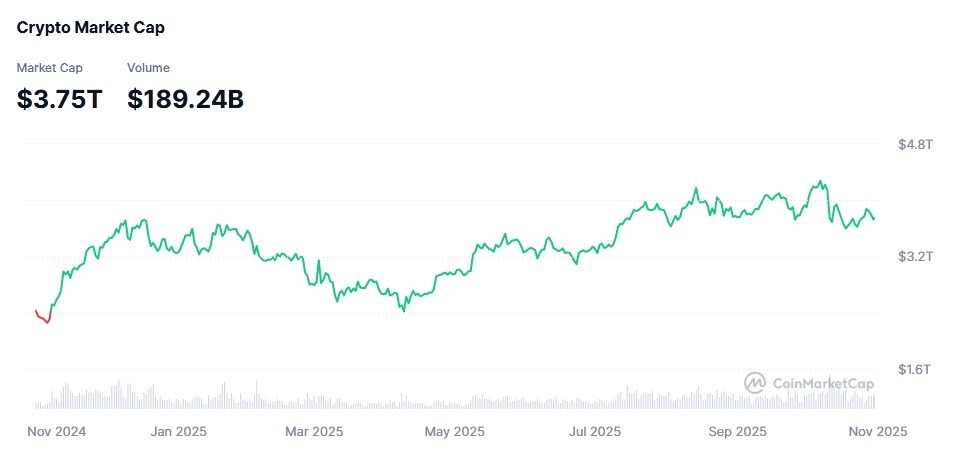
The crypto market closed October with high volatility but intact structural momentum. Total crypto market capitalization sits near 3.8 trillion dollars. On October 10, 2025, trade tensions between the United States and China triggered a severe decline in the crypto market. Prices rebounded somewhat afterwards, yet overall sentiment shifted toward greater caution. Bitcoin traded around 109,000 to 111,000 at the end of the month after peaking above 125,000 earlier in October. Strong institutional interest, especially via U.S. spot Bitcoin ETFs, drives market direction even as short-term outflows and macro uncertainty temper conviction.
In terms of protocol and ecosystem, Ethereum’s upcoming Fusaka upgrade has emerged as a key catalyst, with mainnet launch expected in early December. Meanwhile, derivatives markets and token unlock schedules have added supply and volatility risks, with large options expiries and growing exchange inflows prompting caution. DeFi and on-chain metrics remain healthy, but sentiment is increasingly hinging on near-term event execution.
Onchain and DeFi metrics were mixed. Total value locked and transactional volume remain robust in leading ecosystems, but exchange inflows, token unlock schedules, and ongoing macro commentary from central bankers created a cautious tone among traders.
Top 10 best cryptos to buy now
What is the best cryptocurrency to invest in right now? Although it is impossible to give an exact answer to this question, it's still possible to highlight cryptocurrencies that have a good chance of growth in the long term. Here is our list of the top 10 cryptos to invest in November 2025.
Bitcoin (BTC)
Bitcoin has solidified its position not just as the original cryptocurrency, but as a legitimate macro asset within institutional portfolios. As of late 2025, BTC's investment grade is being reinforced by a surge of institutional adoption, particularly through the continued growth of Bitcoin spot ETFs.
These regulated products have opened the way for pension funds, asset managers, and high-net-worth investors seeking exposure to crypto. ETF inflows during Q4 2025 have demonstrated that institutional demand is not just cyclical, but increasingly structural.
On the technical side, the Bitcoin network's fundamentals remain robust: hash rate and number of active addresses keep going up, showing strong miner and user participation. The upcoming months are expected to bring renewed volatility as macroeconomic data, interest rate expectations, and ETF flows interact to shape market sentiment.
As liquidity deepens and global investors turn cautiously optimistic, BTC’s role as “digital gold” looks more credible than ever. For conservative and balanced crypto portfolios, Bitcoin remains the anchor asset.
Key statistics (as of October 30, 2025):
- Price: $111,525
- Market cap: $2.22T
- All-time high: $126,198
Ethereum (ETH)
Despite competition, Ethereum remains the backbone of the decentralized network: a platform that powers thousands of applications, from DeFi protocols and NFT markets to decentralized autonomous organizations (DAOs). Most major trends in crypto assets trace their roots back to Ethereum. Its developer community remains the largest and most active in the blockchain world, and the network continues to attract institutional attention thanks to its proven security and liquidity depth.
The long-awaited Fusaka upgrade is scheduled for early December 2025. This upgrade represents a major leap in Ethereum’s scalability and efficiency. By enhancing data availability and optimizing rollup performance, it aims to drastically reduce transaction costs and improve throughput across the entire ecosystem. This is not just a technical milestone; it’s a fundamental enabler for the next wave of dApps and enterprise adoption.
Ethereum’s staking model and the growth of its layer-2 solutions, such as Arbitrum, Optimism, and Polygon, reinforce its value proposition. On-chain activity, developer engagement, and total value locked (TVL) metrics remain strong indicators of resilience and innovation.
For investors, ETH combines the long-term security of a blue-chip asset with the growth potential of a technology platform still expanding its reach. If Fusaka launches smoothly, Ethereum could reaffirm its dominance as the central hub of the decentralized economy.
Key statistics (as of October 30, 2025):
- Price: $3,938
- Market cap: $475.63B
- All-time high: $4,953
Chainlink (LINK)
Chainlink occupies a unique position in the crypto landscape. While most blockchain projects focus on execution and scalability, Chainlink serves as a connecting link: the oracle network that securely bridges smart contracts with real-world data and off-chain systems. Its technology underpins critical functions across DeFi, insurance, gaming, and enterprise blockchains, enabling automated systems that respond to verifiable, external information. As DeFi grows more sophisticated, the demand for reliable, tamper-proof data feeds strengthen Chainlink’s relevance and utility.
November 2025 holds promise to be an important month for the project. The upcoming SmartCon 2025 conference, taking place in early November, is expected to unveil new partnerships, product integrations, and advancements in the Cross-Chain Interoperability Protocol (CCIP): a system that allows seamless communication between blockchains. These announcements, coupled with ongoing progress in Chainlink’s staking and reputation mechanisms, could reinforce LINK’s position as a cornerstone of decentralized infrastructure.
For investors, Chainlink offers a combination of technical necessity and steady enterprise adoption. It is not a speculative bet on a niche idea, but a fundamental component of blockchain’s core architecture: a network whose success grows in parallel with the entire crypto ecosystem.
Key statistics (as of October 30, 2025):
- Price: $18.38
- Market cap: $12.8B
- All-time high: $52.88
Solana (SOL)
Solana has firmly established itself as one of the fastest and most scalable layer-1 blockchains in the market, often praised for its ability to handle thousands of transactions per second with minimal fees. Its robust infrastructure has attracted developers from across the crypto spectrum, powering everything from decentralized exchanges (DEX) and NFT marketplaces to DeFi protocols and gaming platforms. Solana’s vibrant ecosystem continues to expand, fueled by its reputation for performance and by an increasingly active community of builders focused on real-world usability rather than speculation.
The final quarter of 2025 marks an important period for Solana’s long-term trajectory. Institutional adoption is accelerating, thanks to the launch of CME-listed Solana futures and options, which have brought mainstream financial exposure to the network’s native token. Meanwhile, ongoing technical upgrades, including optimizations linked to the Firedancer client, aim to further increase network efficiency and resilience.
For investors, evaluating Solana means looking past the hype to tangible adoption. The most important metrics are not just total value locked (TVL), but indicators of genuine user engagement: daily active users, a high volume of transactions, and sustained growth in developer activity.
Key statistics (as of October 30, 2025):
- Price: $195.94
- Market cap: $107.73B
- All-time high: $294.33
Polygon (POL)
Polygon is still a driving force behind Ethereum’s scaling revolution, offering a suite of solutions that make blockchain technology faster, cheaper, and more accessible. Once known primarily for its sidechain, Polygon has evolved into a multi-faceted ecosystem of zero-knowledge rollups and modular scaling frameworks that now support some of the largest dApps in the world. Its developer-friendly infrastructure and deep compatibility with Ethereum have helped it secure partnerships with global brands, governments, and enterprises experimenting with blockchain-based services.
In late 2025, the spotlight is on Polygon’s Rio upgrade, which went live in October and focuses on streamlining payments and improving transaction finality. The upgrade enhances efficiency across Polygon’s network and introduces a more unified framework for future scalability under the Polygon 2.0 vision. November and December are expected to bring early adoption data and potential integration announcements that can solidify POL’s role as a preferred solution for on-chain commerce and enterprise blockchain use cases.
For investors, Polygon offers a balanced profile: the stability of an established project with the growth potential of a scaling leader still expanding its reach. As demand for faster and cheaper blockchain transactions grows, Polygon’s strategy may prove to be a sustainable path to long-term success.
Key statistics (as of October 30, 2025):
- Price: $0.20
- Market cap: $2.05B
- All-time high: $1.29
Arbitrum (ARB)
Arbitrum has emerged as the dominant player among Ethereum’s layer-2 solutions, capturing a significant share of total value locked (TVL) thanks to its efficiency, compatibility, and developer-friendly architecture. Built to scale Ethereum without sacrificing security, Arbitrum enables faster and cheaper transactions by rolling up computation off-chain while settling on Ethereum’s base layer. Its ecosystem has grown rapidly throughout 2025, becoming home to major DeFi protocols, gaming projects, and governance platforms that rely on its robust infrastructure.
For investors, ARB represents a focused bet on Ethereum’s dominance and the inevitable demand for scalable, efficient layer-2 environments. Its combination of strong fundamentals, developer momentum, and a maturing ecosystem gives Arbitrum an edge.
Key statistics (as of October 30, 2025):
- Price: $0.32
- Market cap: $1.74B
- All-time high: $2.40
Sui (SUI)
Sui is positioned as a high performance layer-1 built around an object oriented data model and the Move programming language. Its architecture allows many transactions to execute in parallel, which reduces latency and increases throughput for applications that require real time interactions. That technical focus makes Sui especially well suited for gaming, social apps, marketplaces, and other consumer oriented use cases where user experience matters as much as on chain security.
Throughout 2025 Sui has shown rapid ecosystem growth with increasing developer activity, new tooling for wallet and identity integrations, and early game and NFT deployments that demonstrate the chain's strengths in low latency operations. The presence of developer grants and ecosystem funding has accelerated third party integrations and liquidity provision.
For investors, SUI represents a higher-risk, higher-reward opportunity compared with more established blockchains. Its fundamentals are strong, but it still faces the typical early-stage challenges of adoption and competition.
Key statistics (as of October 30, 2025):
- Price: $2.51
- Market cap: $9.12B
- All-time high: $5.35
Uniswap (UNI)
Uniswap remains the most important DEX in the crypto ecosystem, serving as a gateway for billions of dollars in daily trading volume. Since its inception, it has revolutionized token exchange through automated market maker (AMM) technology and continues to lead in liquidity, innovation, and brand recognition. By late 2025, Uniswap has firmly established itself as the backbone of on-chain trading, supported by integrations across layer-2 networks such as Arbitrum, Optimism, and Polygon. Its multichain presence ensures deep liquidity and seamless user experience across the Ethereum ecosystem and beyond.
From an investment perspective, Uniswap’s strength lies in its adaptability and steady product evolution. The rollout of Uniswap v4 introduced customizable liquidity pools and “hooks,” enabling developers to build new trading models directly within the protocol. This attracted a new wave of market makers.
UNI’s main challenges are regulatory pressure targeting DEXs and the perpetual threat of a more efficient competitor eroding its market-leading position.
Key statistics (as of October 30, 2025):
- Price: $6.12
- Market cap: $3.86B
- All-time high: $44.97
Aave (AAVE)
Aave is an important element of DeFi, providing a decentralized marketplace for borrowing and lending crypto assets. Since its early days, Aave has built a reputation for innovation and reliability, consistently ranking among the top DeFi protocols by TVL. By late 2025, it has become a prominent piece of crypto’s financial infrastructure, with activity spread across multiple chains including Ethereum, Polygon, and Avalanche.
The current focus is on the expansion of Aave v4, a major upgrade that introduces unified liquidity across networks, enhanced risk management, and dynamic interest rate mechanisms. These features aim to improve capital efficiency while reducing systemic risk, addressing some of the challenges that have limited DeFi’s institutional adoption. The rollout of Aave’s GHO stablecoin has also added a new dimension, offering a decentralized and overcollateralized alternative to traditional stable assets.
The primary risks remain inherent to DeFi: the potential for a severe market downturn causing cascading liquidations and bad debt, or a sophisticated smart contract exploit that can put user funds at risk.
Key statistics (as of October 30, 2025):
- Price: $229.69
- Market cap: $3.5B
- All-time high: $666.86
Cosmos (ATOM)
Cosmos has fulfilled much of its early promise as the “Internet of Blockchains,” a network designed to connect independent chains through secure and efficient interoperability. Its Inter-Blockchain Communication (IBC) protocol now underpins a thriving multichain ecosystem, facilitating seamless asset transfers and cross-chain applications. By late 2025, Cosmos has become a foundational layer for dozens of blockchains, from DeFi platforms and gaming projects to real-world asset networks. This expanding web of interconnected blockchains gives Cosmos an enduring relevance that few other ecosystems can match.
Challenges remain, particularly regarding competition from other interoperability-focused projects such as Polkadot and LayerZero. However, Cosmos maintains a unique edge through its mature technology, active developer community, and deep integration into major DeFi ecosystems.
Key statistics (as of October 30, 2025):
- Price: $3.14
- Market cap: $1.49B
- All-time high: $44.70
How to find the best new crypto coin to invest in
Researching new crypto coins effectively requires using the right tools and platforms. A wide range of specialized resources can help investors gather information, analyze data, and assess the potential of early-stage projects.
- Coin aggregators. Platforms like CoinGecko and CoinMarketCap offer detailed listings of new cryptocurrencies, including price data, market capitalization, trading volume, and historical charts. These sites also provide access to official project links such as websites, social media accounts, and whitepapers.
- Launchpads and IDO platforms. Platforms like Polkastarter and Binance Launchpad highlight upcoming token launches. These platforms often conduct preliminary screening, giving investors early access to vetted projects.
- Social media and community hubs. Social media platforms such as X, Reddit, and Telegram provide insight into community sentiment and project activity.
- Project review sites. Websites like Messari, TokenInsight, and CryptoRank publish project analyses, ratings, and reports.
- Data platforms. Resources like DefiLlama provide on-chain data visualizations, DeFi protocol metrics, and ecosystem growth statistics. Tracking liquidity, user activity, and transaction volume can reveal how actively a new project is being adopted.
Using a combination of these tools helps build a comprehensive understanding of new crypto coins. A careful research approach, based on objective data rather than hype, remains the most effective way to identify promising opportunities early.

Suggested Posts
.jpg)


YouHodler is regulated in Switzerland, the EU and Argentina.

YouHodler SA
Registered financial intermediary

YouHodler Italy S.R.L.
Registered as a VASP with the OAM

YouHodler SA
Registered as VASP with Banco de España

YouHodler SA Branch in Argentina.
Registered as a VASP with the CNV.