


Top 10 Cryptocurrencies to Invest in February 2026
.jpg)
Want to find crypto with a good potential to invest in February? We’ve picked out ten options that might be worth a closer look.
Are you looking to invest in cryptocurrencies for the long term but unsure of where to start? With thousands of crypto assets available, it can be overwhelming to decide which ones to invest in. In this article, we will highlight the best crypto to invest in February 2026, focusing on the top 10 cryptocurrencies that have shown resilience and promise.
What are cryptocurrencies?
Cryptocurrencies are virtual currencies that use cryptography for security. Unlike traditional currencies issued by governments, cryptocurrencies operate on decentralized networks based on blockchain technology. This decentralization means that no single entity, such as a central bank, controls the issuance or value of a cryptocurrency.
How does cryptocurrency work?
Cryptocurrencies operate on decentralized networks using blockchain technology, which serves as a distributed ledger that records all transactions across a network of computers, or nodes. Unlike traditional currencies managed by central banks, cryptocurrencies rely on cryptography to secure transactions and control the creation of new units.
When a transaction is initiated, it is broadcasted to the network, where it is verified by nodes through consensus mechanisms like Proof of Work (PoW) or Proof of Stake (PoS). In PoW, miners compete to solve complex mathematical puzzles to validate transactions and add them to the blockchain, earning cryptocurrency as a reward. In PoS, validators are selected based on the amount of cryptocurrency they hold and are willing to "stake" as collateral, ensuring network security and transaction validation without the need for energy-intensive mining.
Cryptocurrencies are stored in digital wallets, which hold the private keys necessary to sign and authorize transactions. These wallets can be software-based or hardware-based, providing various levels of security and accessibility. Transactions are encrypted and recorded on the blockchain, ensuring their integrity and making it nearly impossible to alter past data, while maintaining a certain degree of anonymity for the participants.
How to choose the best crypto coin to invest in
Choosing the best cryptocurrency to invest in requires careful consideration of several factors, given the volatile and complex nature of the cryptocurrency market. Here are key aspects to evaluate when selecting cryptocurrencies for long-term investment:
- Market capitalization. Market cap is a fundamental metric that provides insight into the relative size and stability of a cryptocurrency. It is calculated by multiplying the current price of the cryptocurrency by its total circulating supply. Cryptocurrencies with higher market cap, like Bitcoin and Ethereum, tend to be more stable, making them more suitable for long-term investment. These assets are often seen as "blue-chip" cryptos, with a proven track record of performance and resilience in the market.
- Technology and use cases. The underlying technology and real-world use cases of a cryptocurrency play a significant role in its long-term viability. A cryptocurrency with innovative technology and practical applications is more likely to gain widespread adoption, leading to sustained growth. When evaluating a cryptocurrency, consider its technical features, scalability, security, and the problems it aims to solve.
- Community support and developer activity. A strong, active community and ongoing developer support are vital indicators of a cryptocurrency's potential for long-term success. A vibrant community ensures that there is interest and engagement around the project, which can lead to increased adoption. Similarly, consistent developer activity indicates that the project is continually improving, addressing security vulnerabilities, and staying competitive.
- Tokenomics. Evaluating token distribution, supply mechanisms, and economic incentives is very important. Projects with well-structured tokenomics that promote long-term value creation are generally more attractive than those with high inflation rates or overly concentrated token ownership.
- Security and audits. Reliable projects prioritize security. Independent code audits, bug bounty programs, and public disclosures about security practices can add credibility and reduce the likelihood of vulnerabilities.
- Regulatory environment. Be aware of the legal status of the cryptocurrency in different regions. Cryptocurrencies facing legal challenges or restrictions in major markets may pose higher risks.
- Historical performance. Analyzing the historical performance of a cryptocurrency can provide valuable insights into its potential future performance. While past performance is not a guarantee of future results, it can help identify trends, such as how a cryptocurrency responds to market cycles or external events.
By carefully analyzing these factors, investors can make more informed decisions and identify cryptocurrencies with strong potential for long-term growth.
Crypto market overview
The cryptocurrency market enters February under severe pressure following a major breakdown. Bitcoin crashed through $85,000 support on January 29, hitting a low of $83,300 before recovering to $84,200. Reports indicate that over $800 million in leveraged positions were wiped out as market liquidity dried up during the US trading session. Total market valuation declined across major tokens, and Ethereum and Solana were among the leading decliners in percentage terms.
Multiple factors underlie the decline. Analysis by market outlets highlights geopolitical tension, macroeconomic uncertainty, and risk-off sentiment among investors as key drivers of the sell-off. Continued caution from institutional buyers and weakness in connected markets have exacerbated selling pressure.
The CLARITY Act remains stalled, with Polymarket odds dropping from 80% to 50% after Coinbase withdrew support.
Ethereum shows strong fundamentals: 393,600 new daily wallets, 57% of stablecoins (around $165 billion), and around 65% of RWA tokenization.
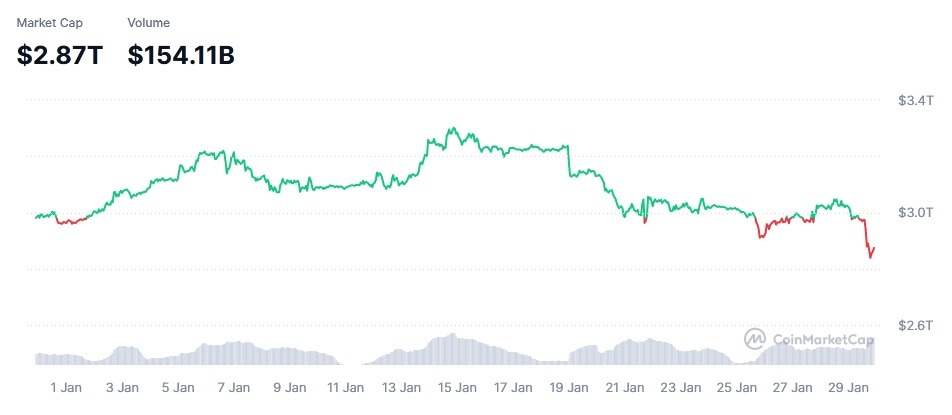
alt: Crypto market cap chart
Top 10 best cryptos to buy now
What is the best cryptocurrency to invest in right now? Although it is impossible to give an exact answer to this question, it's still possible to highlight cryptocurrencies that have a good chance of growth in the long term. Here is our list of the top 10 cryptos to invest in February 2026.
Bitcoin (BTC)
Bitcoin remains the reference point of the crypto market and plays a central role in long-term crypto investment strategies. As the first decentralized crypto asset, BTC benefits from unmatched liquidity, global recognition, and a track record that spans multiple market cycles. Its capped supply of 21 million coins and transparent issuance schedule attract institutional investors seeking an alternative store of value alongside traditional assets.
From a fundamental perspective, Bitcoin’s network security remains robust, supported by sustained hash rate growth and widespread miner participation. Institutional adoption, driven by regulated investment products and custody solutions, has strengthened demand.
Looking ahead to early 2026, macroeconomic factors such as interest rate expectations and capital flows into crypto assets will likely play a significant role in price direction. Bitcoin’s main risks remain short-term volatility and sensitivity to global risk sentiment, but its position as the most established crypto asset makes it a cornerstone holding for conservative and balanced portfolios alike.
Risk tier: Conservative (core holding).
Key statistics (as of January 29, 2026):
- Price: $84,364
- Market cap: $1.68T
- All-time high: $126,198
Ethereum (ETH)
Ethereum maintains its position as the dominant smart contract platform with a market capitalization near $360 billion, trading in the $2,900-$3,200 range as institutional interest in blockchain-based financial infrastructure accelerates. The network has successfully implemented two major upgrades in recent months: Pectra in May 2025, which introduced account abstraction and validator improvements, and Fusaka in December 2025, which expanded blob capacity through PeerDAS while increasing the gas limit from 45-60 million to about 150 million. These technical enhancements position Ethereum for substantial throughput improvements as the upcoming Glamsterdam upgrade in mid-2026 promises to deliver parallel processing and zero-knowledge proof integration, potentially pushing performance to 10,000 transactions per second.
With $12.33 billion in spot ETF assets and growing adoption by traditional financial institutions for asset tokenization, Ethereum has become the de facto settlement layer for on-chain capital markets. The network hosts the majority of DeFi protocols, dominates the NFT sector, and serves as the major platform for stablecoin issuance. Recent upgrades have laid the groundwork for institutional-grade applications that require predictable transaction costs and high throughput.
Risks include competition from alternative smart contract platforms and reliance on Layer-2 adoption, yet Ethereum’s depth, flexibility, and network effects still position it as a core holding for medium- to long-term investors.
Risk tier: Moderate to Conservative.
Key statistics (as of January 29, 2026):
- Price: $2,814
- Market cap: $340.24B
- All-time high: $4,953
Solana (SOL)
Solana has established itself as one of the most prominent high-performance Layer-1 blockchains, designed for fast execution, low transaction costs, and large-scale applications. Its value proposition is straightforward: enable on-chain activity that feels comparable to traditional web platforms, while keeping fees low enough to support high-frequency use cases such as trading, gaming, and payments. Over the past cycles, Solana has built a strong identity around speed and usability, which has helped it attract both developers and retail liquidity.
The network stands on the brink of transformative technical upgrades that could redefine blockchain performance standards. Firedancer, the high-performance validator client, already secures 20.9% of network stake across 207 validators and targets throughput exceeding one million transactions per second. Combined with Alpenglow, which completed testnet deployment in December 2025 and aims for mainnet launch in Q1 2026, Solana is positioning to achieve 150-millisecond finality: a user experience approaching traditional web applications.
Fundamentally, Solana’s ecosystem has expanded across DeFi, NFTs, and memecoin-driven trading activity, often translating into bursts of network usage and liquidity inflows. Developer attraction remains a key strength, supported by a growing set of tooling and infrastructure providers.
The primary risks revolve around network stability concerns stemming from historical outages, validator centralization concerns, and intense competition from Ethereum scaling solutions and other Layer-1 chains.
Risk tier: Moderate.
Key statistics (as of January 29, 2026):
- Price: $117
- Market cap: $66.46B
- All-time high: $294.33
Binance Coin (BNB)
BNB remains one of the most influential exchange-linked assets in crypto, supported by a combination of utility, liquidity, and strong integration across the Binance ecosystem. Its primary value drivers come from real usage rather than pure narrative: trading fee discounts, participation in token launches, and broad functionality across Binance’s products. This creates a steady baseline demand profile that many smaller utility tokens struggle to achieve.
The deflationary tokenomics of BNB provide structural price support through the quarterly burn mechanism, where Binance uses a portion of trading fee revenue to permanently remove tokens from circulation. Transaction volume and gas usage on BNB Chain have remained robust despite increased competition from other Layer-1 networks, with particular strength in gaming and DeFi applications that benefit from low transaction costs and fast settlement.
The Fermi Hard Fork on BSC in January 2026 reduced block times to 0.45 seconds, improving user experience and enabling more complex smart contract interactions. This upgrade positions BNB Chain as increasingly competitive with faster networks like Solana while maintaining the security and liquidity advantages of the broader Binance ecosystem.
The primary risk centers on regulatory scrutiny of Binance itself, as any adverse regulatory action against the exchange could materially impact BNB's value. Additionally, concerns about centralization, both of the exchange and the validator set securing BNB Chain, create tension with blockchain's decentralization philosophy.
Risk tier: Moderate.
Key statistics (as of January 29, 2026):
- Price: $864
- Market cap: $117.89B
- All-time high: $1,370
Chainlink (LINK)
Chainlink is widely viewed as the leading oracle network in crypto, solving a critical problem: connecting smart contracts to real-world data and external systems. This makes Chainlink less dependent on short-lived hype cycles and more tied to the growth of the broader blockchain economy, where data integrity and automated execution are non-negotiable.
Fundamentally, LINK benefits from deep integration across major DeFi protocols, lending markets, and derivatives platforms. Its role has expanded beyond price feeds into more advanced services such as cross-chain messaging and secure data delivery. As tokenized assets and institutional-grade on-chain finance develop further, demand for trusted middleware can increase, positioning Chainlink as a key infrastructure layer rather than just another speculative asset.
Institutional partnerships validate Chainlink's position as essential infrastructure for the tokenization of traditional assets. The upcoming deployment of the Automated Compliance Engine (ACE), launched in early access in 2025, aims to provide real-time regulatory compliance checks for tokenized securities, addressing a critical barrier to institutional adoption.
The primary risks are slower-than-expected growth in DeFi activity and competition from specialized oracle providers.
Risk tier: Moderate.
Key statistics (as of January 29, 2026):
- Price: $11.10
- Market cap: $7.86B
- All-time high: $52.88
Avalanche (AVAX)
Avalanche is a high-performance smart contract platform built to support fast finality, scalable on-chain applications, and customizable blockchain deployments. Its strongest differentiator is the ability to create specialized networks, often referred to as subnets, that can be tailored for specific use cases.
Avalanche has maintained an active DeFi and infrastructure ecosystem, supported by bridges, decentralized exchanges (DEXs), and lending markets that contribute to recurring on-chain activity. The subnet model also gives Avalanche a pathway to attract projects that want dedicated performance, compliance features, or predictable costs without relying entirely on a shared base chain.
Real-world asset tokenization represents a strategic focus area with distinct progress. Partnerships with Intain for securitization, Securitize for digital securities, and FIS for traditional finance infrastructure demonstrate institutional validation of the technology. The October 2025 burn of 70,000 AVAX tokens marked the highest deflationary period since 2023, indicating network usage that translates to token value accrual through the fee burn mechanism.
The primary risks involve execution on institutional partnerships, where blockchain projects often announce relationships that fail to generate meaningful transaction volume, and intense competition in the Layer-1 space.
Risk tier: Moderate to High.
Key statistics (as of January 29, 2026):
- Price: $11.02
- Market cap: $4.75B
- All-time high: $146
Polygon (POL)
Polygon represents one of Ethereum’s most ambitious scaling and interoperability solutions. Rather than competing directly with Ethereum, Polygon’s long-term aim is to expand Ethereum’s reach by providing faster, cheaper execution environments while maintaining strong alignment with Ethereum’s security and developer ecosystem. The Chain Development Kit (CDK) enables developers and enterprises to launch customized Layer-2 networks that inherit Ethereum's security while maintaining application-specific optimizations. This positioning makes POL an infrastructure bet for investors who believe Ethereum will remain the dominant settlement layer, but that most user activity will increasingly move to scalable networks built around it.
The partnership portfolio distinguishes Polygon from purely technical scaling solutions, bringing mainstream brands into the blockchain space. These relationships provide revenue visibility and demonstrate that enterprise adoption extends beyond financial applications to consumer-facing products requiring low transaction costs and familiar user experiences.
The primary risk comes from intense Layer-2 competition including Arbitrum, Optimism, and Base.
Risk tier: High to Moderate.
Key statistics (as of January 29, 2026):
- Price: $0.11
- Market cap: $1.19B
- All-time high: $1.29
Sui (SUI)
Sui is a newer-generation Layer-1 blockchain designed for high throughput, low latency, and a smoother user experience for consumer-scale applications. Its architecture is built to handle large volumes of transactions efficiently, which makes it especially relevant for sectors like gaming, social applications, and on-chain trading where speed and cost predictability matter.
Sui’s momentum depends on developer adoption, active users, and the ability to attract meaningful liquidity into its DeFi stack. Importantly, institutional adoption accelerated substantially with Grayscale launching the Sui Trust, Bitwise intending to include SUI in its crypto index ETF, and asset managers 21Shares and VanEck offering SUI-related products.
The 2026 roadmap includes transformative developments: protocol-level private transactions using zero-knowledge proofs to attract privacy-sensitive users, evolution to S2 (Sui StackStack) as a unified developer platform, USDsui stablecoin launch, and DeepBook v3 DEX with margin trading capabilities. The cross-chain bridge to Ethereum and SuiNS naming service will enhance interoperability and user onboarding.
The primary risk involves intense competition from established Layer-1s with larger ecosystems and liquidity. Token unlock pressure continues through 2026 as vesting schedules release supply, potentially creating sustained selling pressure if recipients liquidate holdings.
Risk tier: High.
Key statistics (as of January 29, 2026):
- Price: $1.32
- Market cap: $5B
- All-time high: $5.35
Litecoin (LTC)
Litecoin is one of the longest-running cryptocurrencies, often positioned as a practical payment-focused asset with strong uptime, predictable issuance, and wide exchange support. While it rarely dominates headlines, LTC has maintained relevance through consistency: fast confirmations, low transaction fees, and a network that has operated reliably across multiple market cycles.
Fundamentally, Litecoin’s strength lies in its simplicity and resilience. It is widely integrated across trading platforms, payment processors, and crypto infrastructure providers, which supports liquidity and accessibility. The network’s proof-of-work design also creates a familiar security model for investors who prefer mining-based systems. In addition, recent integration of MimbleWimble Extension Blocks (MWEB) provides optional privacy features, addressing a historical weakness compared to privacy-focused alternatives. The planned smart contract support via the Litecoin Virtual Machine (LitVM) could also have a positive impact on the price.
The key risks are limited ecosystem growth compared to modern Layer-1 networks, fewer high-profile catalysts, and the possibility that investor attention remains concentrated on faster-growing narratives.
Risk tier: Moderate.
Key statistics (as of January 29, 2026):
- Price: $66.10
- Market cap: $5.07B
- All-time high: $412
Bittensor (TAO)
Bittensor positions itself at the intersection of artificial intelligence and blockchain technology, creating a decentralized network where machine learning models compete to provide computational services and earn rewards based on performance. The protocol implements a unique incentive mechanism that theoretically aligns participants toward producing increasingly capable AI models through market-based selection rather than centralized curation. With a fixed supply cap of 21 million tokens mirroring Bitcoin's scarcity model, TAO attempts to capture the narrative of "AI's native currency" while building infrastructure for distributed machine learning that operates independently of centralized providers like OpenAI or Anthropic.
TAO’s value proposition depends on real usage and the quality of the network’s output, meaning adoption is not just measured by transactions, but by whether the ecosystem produces results that developers and businesses actually want. The project’s design encourages competition between AI subnets, which can create an environment where better-performing contributors earn more rewards, supporting long-term network improvement.
The fundamental challenge facing Bittensor involves proving that decentralized AI training can compete with centralized alternatives on cost, performance, and reliability.
Risk tier: High.
Key statistics (as of January 29, 2026):
- Price: $221
- Market cap: $2.35B
- All-time high: $767
How to find the best new crypto coin to invest in
Researching new crypto coins effectively requires using the right tools and platforms. A wide range of specialized resources can help investors gather information, analyze data, and assess the potential of early-stage projects.
- Coin aggregators. Platforms like CoinGecko and CoinMarketCap offer detailed listings of new cryptocurrencies, including price data, market capitalization, trading volume, and historical charts. These sites also provide access to official project links such as websites, social media accounts, and whitepapers.
- Launchpads and IDO platforms. Platforms like Polkastarter and Binance Launchpad highlight upcoming token launches. These platforms often conduct preliminary screening, giving investors early access to vetted projects.
- Social media and community hubs. Social media platforms such as X, Reddit, and Telegram provide insight into community sentiment and project activity.
- Project review sites. Websites like Messari, TokenInsight, and CryptoRank publish project analyses, ratings, and reports.
- Data platforms. Resources like DefiLlama provide on-chain data visualizations, DeFi protocol metrics, and ecosystem growth statistics. Tracking liquidity, user activity, and transaction volume can reveal how actively a new project is being adopted.
Using a combination of these tools helps build a comprehensive understanding of new crypto coins. A careful research approach, based on objective data rather than hype, remains the most effective way to identify promising opportunities early.

Suggested Posts



YouHodler is regulated in Switzerland, the EU and Argentina.

YouHodler SA
Registered financial intermediary

YouHodler Italy S.R.L.
Registered as a VASP with the OAM

YouHodler SA
Registered as VASP with Banco de España

YouHodler SA Branch in Argentina.
Registered as a VASP with the CNV.