


Cryptocurrency Market 2026: Key Trends and What to Expect
What to Expect
Wondering what to expect from crypto in 2026? We break down the biggest trends coming your way, from new regulations to tokenized real world assets and everything in between.
The crypto market entering 2026 shows clear differences from earlier growth phases, driven by tighter regulatory oversight, expanded institutional products, and more evolved use cases. These factors are influencing how crypto assets are issued, traded, and integrated into existing financial systems. This article examines crypto market trends expected in 2026 and their potential impact on market structure.
Current market context
“Neither Bitcoin nor Ethereum has delivered the year-end rally many anticipated, leaving market participants questioning what these divergent patterns reveal about the broader crypto ecosystem.” - Investing.com
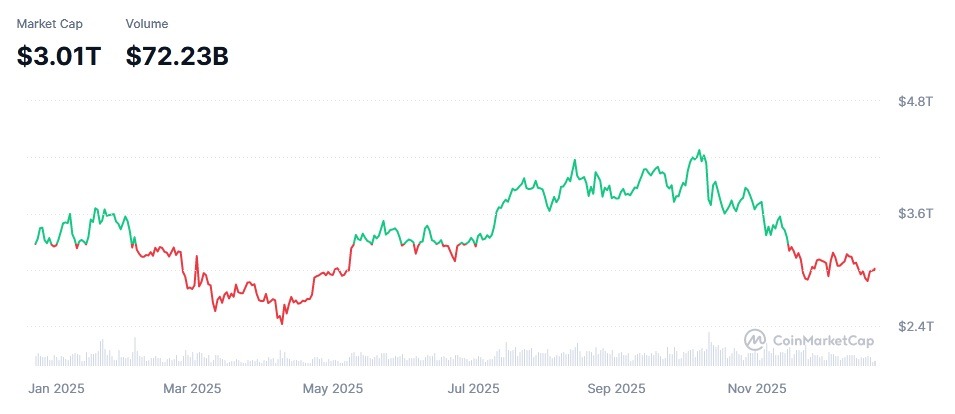
As the end of 2025 approaches, the cryptocurrency market shows predominantly sideways price action alongside increased volatility. The final quarter of the year marked a clear transition from the strong growth seen earlier in 2025 to a period of correction, consolidation, and selective risk taking. Some analysts argue that the crypto bull run of 2025 has ended and that the market may be entering a new “crypto winter.” Others take a more optimistic view, interpreting current conditions as a deep correction rather than the end of the cycle, with the potential for renewed growth.
During the last two months of 2025, total crypto market capitalization declined to roughly the 2.9 to 3.1 trillion US dollar range, which is significantly lower than the recent highs above 4 trillion. This pullback was not driven by a single shock event, but rather by a combination of profit taking after a strong run, reduced liquidity, and ongoing uncertainty in global financial conditions. Risk assets broadly experienced pressure during the same period, and cryptocurrencies continued to show sensitivity to macroeconomic signals such as interest rate policy and capital flows.
Bitcoin outperformed most other segments of the market on a relative basis, despite posting a meaningful decline of its own. While prices fell roughly 25 to 30 percent from recent peaks, Bitcoin’s share of total market capitalization increased, reflecting a shift toward assets perceived as more resilient during drawdowns. Ethereum and most major altcoins experienced deeper corrections, with many speculative segments underperforming the broader market.
Market sentiment indicators during this period consistently pointed to elevated levels of fear. Historically, such readings have often appeared near local bottoms, but they do not guarantee a reversal. What they do indicate is a cautious investor base that has shifted focus from rapid growth expectations to capital preservation and risk control.
Bitcoin and Ethereum: projected market positions in 2026
Bitcoin in 2026: consolidation as a dominant store of value
Bitcoin is expected to retain its position as the primary reference asset of the crypto market in 2026. Most institutional research published in late 2025 still views Bitcoin primarily as a store of value and portfolio hedge rather than a high growth speculative asset.
Forecasts for 2026 cluster around several broad scenarios:
- In a base case, Bitcoin trades within a wide range roughly between $100,000 and $140,000, reflecting steady institutional inflows balanced by profit taking and macro uncertainty.
- In a bullish scenario, renewed demand from spot ETF products and improved liquidity could push prices above the previous all-time high.
- In a bearish scenario, tighter global liquidity or macro uncertainty could lead to extended consolidation or deeper drawdowns, with some analysts placing downside risk below $75,000.
Despite diverging price targets, there is broad agreement that Bitcoin’s market share is likely to remain high. For 2026, Bitcoin’s growth outlook is therefore expected to be incremental rather than explosive, with volatility driven more by macro signals than by internal network changes.
Ethereum in 2026: utility driven growth with higher uncertainty
Ethereum enters 2026 with a different profile. Its valuation remains closely tied to network usage, transaction demand and the broader health of decentralized finance (DeFi) and Layer 2 ecosystems.
Projections for Ethereum in 2026 show wider dispersion than for Bitcoin:
- Baseline forecasts place Ethereum in the $3,000 to $5,000 range, assuming moderate growth in on-chain activity and continued adoption of scaling solutions.
- More optimistic models suggest higher levels if application demand accelerates.
- More bearish outlooks highlight the risk of Ethereum underperforming if competition from alternative smart contract platforms intensifies or if usage growth stagnates.In this scenario, ETH could drop below $2,000.
Unlike Bitcoin, Ethereum’s market position in 2026 is less about dominance and more about relevance. Its long term value proposition depends on sustained developer activity, stable fee economics and its ability to remain the settlement layer for decentralized applications (dApps). This creates greater upside potential but also greater sensitivity to execution and adoption risks.
Major crypto market trends in 2026
Global regulatory developments
The most obvious trend that will inevitably continue in 2026 is the regulatory activity affecting the cryptocurrency market. Depending on the jurisdiction, this could mean either establishing clearer rules or imposing restrictions, or possibly both.
In the European Union, the Markets in Crypto-Assets Regulation (MiCA) is moving toward full enforcement, requiring licensing for crypto-asset service providers and setting reserve and reporting requirements for stablecoins; many firms are working to comply with these standards by mid-2026.
In the United Kingdom, the Financial Conduct Authority (FCA) has opened consultations on comprehensive crypto rules, with final frameworks aimed for completion by the end of 2026 and enforcement beginning ahead of broader legislation in 2027.
In the United States, proposals such as the GENIUS Act for stablecoin regulation and new initiatives like a planned “crypto innovation exemption” at the Securities and Exchange Commission (SEC) signal potential shifts in how digital assets are classified and supervised beginning in 2026.
Outside Western markets, regulators in regions such as Hong Kong are preparing licensing schemes for stablecoin issuers in early 2026, and various national frameworks continue to emerge in response to global financial oversight efforts.
Institutional participation and capital flows
Institutional participation is expected to remain a major factor for crypto markets in 2026, with capital flows increasingly shaped by regulated investment products, financial infrastructure integration, and corporate balance-sheet decisions. Compared with earlier cycles, institutional exposure is becoming more structured and linked to long-term allocation strategies rather than short-term trading. These dynamics influence liquidity conditions, volatility patterns, and the relative performance of major crypto assets.
In 2025, spot Bitcoin and Ethereum exchange-traded funds (ETFs) have attracted substantial institutional inflows, with combined assets under management in these products exceeding more than $115 billion by late 2025.
In 2026, spot Bitcoin and Ethereum ETFs are likely to represent a stable channel for institutional capital rather than a one-time inflow event. Asset growth is expected to slow compared with initial launch periods, but trading volumes and secondary-market liquidity may increase as ETFs become embedded in portfolio management, retirement products, and discretionary mandates. This maturation process may reduce some speculative price pressure while reinforcing demand linked to broader market cycles and macro conditions.
Beyond ETFs, traditional financial institutions are enhancing infrastructure to support institutional capital flows into crypto. Global banks and custodians are developing or expanding custody services intended to meet institutional security and compliance requirements, with major firms planning dedicated crypto custody offerings in 2026.
Furthermore, surveys of institutional investors indicate a majority plan to increase crypto asset exposure and to allocate capital toward tokenized assets, reflecting a broader interest in integrating crypto assets into diversified financial strategies.
Decentralized finance (DeFi): maturity and limits
DeFi continues to expand beyond early experimentation into more structured financial activity, with growth expected to persist through 2026. Total value locked (TVL) and capital allocated to DeFi protocols have grown, and forecasts indicate higher institutional participation. Experts anticipate that in 2026, cross-chain liquidity, interoperability solutions, and automation tools will become more widespread, supporting unified markets and diversified yield strategies across multiple blockchain ecosystems.
However, security risks and protocol vulnerabilities still present limits; despite advances in audits and monitoring tools, high-profile exploits demonstrate ongoing challenges in protecting smart contracts and user funds. Regulatory pressure and compliance expectations will also influence the development of protocols.
User experience and adoption barriers remain, with wallet complexity, scalability issues, and variable liquidity across networks still limiting broader retail engagement. Progress in layer-2 scaling, modular architectures, and simplified interfaces is expected to improve access, but mainstream utility beyond trading and speculation will remain limited in 2026.
Stablecoins and central bank digital currencies (CBDSs)
Stablecoins and CBDCs are both forms of digital money, but they differ fundamentally in issuance, governance, purpose, and underlying principles. Stablecoins are privately issued tokens pegged to fiat currencies and widely used for trading, payments, and providing liquidity in crypto markets, with total stablecoin supply and usage continuing to grow.
Regulatory frameworks such as the GENIUS Act have introduced clearer requirements for reserve backing and compliance, encouraging new stablecoin issuers to develop fully reserved dollar-pegged tokens that aim for broad settlement use. Recent pilots also explore stablecoin settlement for bank transactions through established networks, with broader implementation expected in 2026.
In contrast, CBDCs are issued directly by central banks and intend to serve as sovereign programmable digital money, fully controlled by the government. Over 130 countries are reported to be researching or piloting CBDCs with some projects targeting phased launch or expanded testing in 2026.
Looking toward 2026, stablecoins are expected to expand their use in payments, remittances, and programmable settlement, particularly in regions where traditional systems remain inefficient. At the same time, regulatory pressure is likely to increase in jurisdictions pursuing CBDC deployment, with efforts to limit the systemic role of privately issued stablecoins in favor of sovereign digital currencies.
Tokenization of real-world assets (RWA)
Tokenization of real-world assets involves representing traditional financial and tangible assets on a blockchain as digital tokens that can be bought, sold, or traded. The segment has seen rapid growth, with the total value of tokenized RWAs on chains exceeding tens of billions of dollars in 2025, primarily driven by tokenized private credit and U.S. Treasury debt, and supported by clearer regulatory conditions in major markets.
Institutional participation is increasing, with major banks and asset managers such as JPMorgan, Goldman Sachs, BlackRock and Franklin Templeton launching or planning tokenized fund products and investment vehicles that leverage blockchain for more efficient issuance and settlement.
Tokenization enables fractional ownership of otherwise illiquid assets, which can lower entry barriers and allow a wider range of investors to participate in markets like real estate, private credit, and commodities. It can also be integrated with DeFi applications, where tokenized assets can be used as collateral or for liquidity provisioning across compatible blockchains.
Looking toward 2026, growth in RWA issuance and trading is expected to continue, supported by institutional demand, regulatory clarity in key jurisdictions, and improvements in technical infrastructure that aim to lower transaction costs and expand fractional ownership. However, the pace and form of adoption will vary by asset type and market, reflecting ongoing work on compliance, custody standards, and interoperable settlement systems.
Infrastructure, scalability, and interoperability
Blockchain infrastructure has progressed toward supporting higher throughput, lower costs, and broader network connectivity, but key technical challenges remain as usage grows. Layer 2 scaling solutions, including ZK-Rollups and Optimistic Rollups, are increasingly being adopted to reduce congestion on major base networks and to cut transaction costs, with adoption projected to rise in 2026.
Interoperability protocols that connect separate blockchains are becoming more prominent as multi-chain activity increases, allowing tokens and data to move securely between ecosystems and reducing liquidity fragmentation. Standards and cross-chain bridges are being refined to support asset transfers across networks and improve composability for dApps.
Despite improvements, challenges remain in establishing seamless cross-chain communication, consistent security guarantees, and standardized messaging across disparate networks. Continued development of interoperability protocols, cross-chain verification tools, and network-agnostic settlement layers is expected through 2026, laying groundwork for broader institutional use and more complex decentralized services.
Security standards and privacy technologies
2025 was one of the worst years ever for total losses from cryptocurrency hacks, with particularly high-profile incidents at Bybit and mass thefts from centralized services and wallets. These events heightened attention to security issues, which will influence technological and regulatory trends in 2026.
Cryptographic techniques like zero-knowledge proofs (ZKPs) and multi-party computation are expected to move from experimental use toward broader implementation in 2026. ZKPs, for example, allow verification of transaction properties without revealing underlying data, supporting confidential transactions that can comply with regulatory audits without exposing sensitive information. These methods are influencing both security and privacy toolsets across networks and applications.
The marked interest in privacy-oriented cryptocurrencies in late 2025, especially Zcash (ZEC) and Monero (XMR), highlights market responses to surveillance concerns and regulatory tightening. Zcash’s price surge has been supported by increased institutional involvement, growth in the coin’s shielded transaction pool, and upgrades that improve user experience for confidential transactions. Meanwhile, Monero’s steady gains reflect growing demand for default privacy features, though regulatory scrutiny and exchange listing restrictions have constrained broader access. This privacy-oriented trend is likely to continue into 2026.
Geopolitical and macroeconomic influences
Geopolitical events and macroeconomic conditions are shaping cryptocurrency markets now and will do so in 2026. Cryptocurrencies have become sensitive to global political tensions, trade conflicts, and economic policy shifts, with price movements often reflecting broader investor risk sentiment and capital reallocation across asset classes. For example, escalation in Middle East conflicts contributed to a significant sell-off in major digital assets in mid-2025, as investors reduced exposure to risk-oriented markets.

Suggested Posts





YouHodler is regulated in Switzerland, the EU and Argentina.

YouHodler SA
Registered financial intermediary

YouHodler Italy S.R.L.
Registered as a VASP with the OAM

YouHodler SA
Registered as VASP with Banco de España

YouHodler SA Branch in Argentina.
Registered as a VASP with the CNV.